
Where should the calibration board go next? NextView is an agent that calibrates a camera by deciding, frame by frame, where the ChArUco board should be placed. Each step it inspects the new frame with OpenCV 5 tools, rejects bad frames with a measured reason (slanted-edge blur on the board's own edges, glare, a board that is missing or too small), refits the camera, maps the per-pixel uncertainty of the calibration over the whole image, and asks for the pose predicted to shrink that uncertainty most. A person approves every lens-model change and every export. The agent stops when a calibrated probability says the full-image error is below target, and declines lenses it cannot model.
- Live endpoint: https://t4zn85l054.execute-api.ap-southeast-1.amazonaws.com (AWS Lambda container behind an API Gateway HTTP API, ap-southeast-1)
- Technical report:
docs/report.pdf(sourcedocs/report.md); architecture:docs/architecture.svg - Pre-registration:
docs/preregistration.md; results:results/ - Demo video: https://youtu.be/0aQBOavDezg (4:23, synthetic narration, burned-in captions; caption file
docs/video/nextview-demo.srt) - Team: Umar Mohktar, Singapore (solo entrant: design, implementation, evaluation). GitHub: GitHubMoreLikeGitGud


The endpoint is throttled to 2 requests/s with at most 5 concurrent executions; when it is busy the page shows "Busy — retrying" and retries on its own.
- Open the live endpoint. The Simulator tab is selected with the preset Wide-angle robot cam, hand-held and the Human actuator. Press Start (the first request may take a few seconds while the container and the simulated camera warm up), then Auto-run.
- Watch the Agent trace on the right. Each line is one decision with the measurement behind it:
R2_BLURrejects a frame and names the motion direction,R0_NO_BOARDmoves on to the next-ranked candidate,R13_NBVsays where the uncertainty is largest and where the board goes next. The dashed ghost outline on the frame is the next target, and the candidate table shows the predicted gain and effort of the top five poses (click a row to override the choice). Tick Uncertainty 32×18 to see the per-pixel map. - After 12 or more views, the wide lens trips the lens-model check: auto-run pauses on a switch_model approval card with the radial-trend p-value, held-out errors of both models and a residual vector field. Press Switch to rational model (or Keep k5 (pin model), which pins the model while planning continues).
- When
R11_STOPfires (the probability that the true full-image p95 exceeds 0.75 px is below 0.10), the export card asks for approval; if the budget runs out first,R12_BUDGETasks whether to accept with warnings (Accept with warnings). Press Export calibration to get the OpenCV YAML, the report-card PNG and the JSON trace (download links expire after an hour). - The race chart plots the simulator's true error against a random-pose shadow track on the same camera. A single session is not evidence: after an approved model switch it mixes view planning with the better lens model. Policy comparisons are in the pre-registered benchmark (report §8).
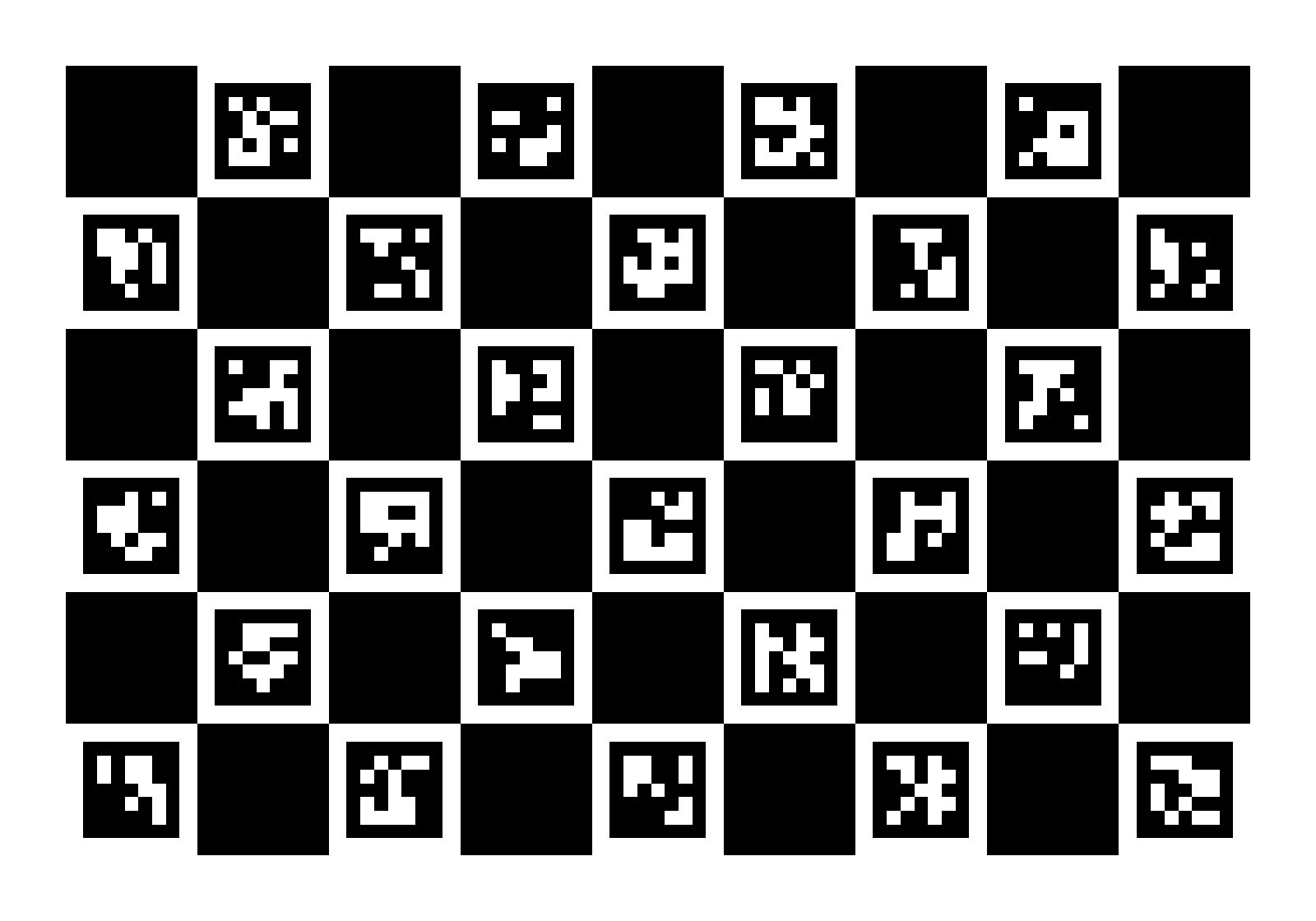
- Optional: the Webcam tab runs the same agent on a real camera. On your phone, open https://t4zn85l054.execute-api.ap-southeast-1.amazonaws.com/api/board.png?kind=screen (the page's "Show this board on your phone" link), point the computer's camera at it, then Start camera, Start session, Capture. Frames are processed in memory and never stored.
- The Evidence tab shows the benchmark's headline numbers, figures E1–E12 and the failure gallery, baked into the image from
results/at deploy time; the About tab lists the data attribution and the limits.
From the pre-registered synthetic TEST split (6,600 runs: 100 simulated cameras × 3 seeds × robot/human actuators × 11 policies, exact ground truth; numbers from results/synth_test/summary.json):
| Pre-registered endpoint (A = agent, B0 = random poses) | Robot | Human |
|---|---|---|
| True full-image p95 error after 10 frames, A vs B0 (median, px) | 1.21 vs 2.71 | 1.22 vs 3.61 |
| Paired median difference [95 % CI], Holm-corrected p | −1.44 [−1.79, −1.05], 3.8 × 10⁻¹⁵ | −1.91 [−2.97, −1.09], 3.8 × 10⁻¹⁵ |
| Frames until true p95 < 1 px, A vs B0 (median; 31 = not reached) | 8 vs 31 | 10 vs 31 |
All eight endpoints (against random poses, a textbook template and an emulation of OpenCV's interactive-calibration app) favour the agent after Holm correction. Results that go against the stated hypotheses are reported too: the perception gate adds no accuracy in simulation and costs a hand-held operator extra attempts; on real METRIC data the agent's frame selection is not consistently better than random; the first-order uncertainty map under-covers and the stop rule never stops on telephoto lenses. See the report for the full evaluation, failure cases and limitations.
Python 3.12 is required (requires-python >=3.12,<3.13). Use a fresh virtual environment: the global opencv-python package and the headless one both provide cv2.
py -3.12 -m venv .venv
.venv\Scripts\pip install -r requirements-dev.txt       # pinned; requirements-dev.lock.txt is the exact Windows environment
.venv\Scripts\pip install -e . --no-deps
.venv\Scripts\python scripts\bake_evidence.py                        # fills the local Evidence tab (git-ignored build output)
.venv\Scripts\python -m nextview.lambda_app.devserver --port 8765    # open http://localhost:8765
On Linux or macOS use python3.12 -m venv .venv and .venv/bin/.... The dev server wraps the same Lambda handler (each HTTP request becomes an API Gateway v2 event); without NEXTVIEW_STATE_KEY it uses a random per-process key and keeps exports in memory.
Run the agent without the web UI:
.venv\Scripts\python scripts\agent_presets.py --out results\tmp\presets.json      # all six presets, end to end
.venv\Scripts\python -m nextview.mcp_server.server                                   # MCP server over stdio
.venv\Scripts\python -m nextview.mcp_server.llm_driver --model qwen2.5:7b --approval ask   # needs a local Ollama
The MCP server exposes the same tools as the endpoint (sim_new_session, sim_capture, detect_board, assess_frame, accept_view, calibrate, uncertainty_map, residual_analysis, propose_next_views, drop_view, export_calibration, plus image_new_session and observe_image for image files). Model changes and exports ask the human through MCP elicitation; a client that cannot elicit gets needs_approval.
.venv\Scripts\python -m pytest            # default: -m "not slow and not live"
.venv\Scripts\python -m pytest -m slow    # slow tests (blur curve and similar)
pwsh infra/smoke_test.ps1 -Url https://t4zn85l054.execute-api.ap-southeast-1.amazonaws.com   # live endpoint
The default suite gives 362 passed, 6 skipped (need data_ext/ from scripts/fetch_metric.py and the OpenCV samples), 2 deselected; 368 with the data (about 2.5 minutes, single process). The tests cover the renderer's corner bias, the ESF blur estimate, pose and IPPE ambiguity, the Schur-complement covariance against brute force and Monte Carlo, the NBV planner, every policy rule and approval gate, the signed state token, the Lambda handler (caps, CSP, logs without image data), the benchmark statistics and the MCP server.
Every number in the report is read from results/ by docs/tools/build_report.py; see results/README.md for which command produced each file. Runs are deterministic (single-threaded OpenCV and BLAS).
$py = ".venv\Scripts\python"
& $py -m nextview.bench.run_synthetic --split dev --out results/synth_dev                 # DEV: cameras 0-39, A and B0
& $py -m nextview.bench.fit_stop --runs results/synth_dev/runs.csv --out config/stop_calibration.json
& $py -m nextview.bench.run_synthetic --split test --out results/synth_test               # TEST: 6,600 runs
& $py -m nextview.bench.summarize --runs results/synth_test                               # pre-registered endpoints
& $py -m nextview.bench.consequence --runs results/synth_test                             # mm table
& $py -m nextview.bench.run_synthetic --split failure --out results/synth_failure         # abstention set
& $py -m nextview.bench.gallery --out results
& $py -m nextview.bench.plots                                                             # results/figures
& $py scripts\fetch_metric.py                                                             # METRIC subsets via HTTP range reads
& $py -m nextview.bench.run_pool --out results/pool                                       # real-data pool protocol
& $py -m nextview.bench.llm_row --models qwen2.5:7b --out results/llm_row                 # LLM row; needs Ollama
The TEST run took 64 minutes on 14 worker processes (results/synth_test/meta.json); --workers sets the count. The full TEST runs.csv (46 MB) is not committed; runs_core.csv.gz holds every row and metric (rounded to 3–4 significant digits) and the runner regenerates the full file exactly. The frozen thresholds, stop calibration and source-tree hashes are listed in docs/preregistration.md.
Check the pre-registration and the endpoints without re-running the benchmark (seconds, committed files only):
New-Item -ItemType Directory -Force results/tmp | Out-Null      # git-ignored output folder for the two checks below
& $py scripts\verify_prereg.py                                  # recompute the frozen hashes from results/prereg/, list what changed since
& $py -m nextview.bench.summarize --runs results/synth_test --out results/tmp/summary_check.json   # PE1-PE8 from runs_core.csv.gz
& $py -m nextview.bench.consequence --runs results/synth_test --inversion-only --out results/tmp/inversion_check.json
Values from the compact table can differ from summary.json in their last digits (rounding); the endpoint decisions are the same.
Documentation build (optional; uses markdown 3.10.2 and playwright 1.62.0 with its Chromium):
pip install markdown==3.10.2 playwright==1.62.0; python -m playwright install chromium
python docs\tools\draw_architecture.py      # docs/architecture.svg + .png
python docs\tools\build_report.py # docs/report.md (from docs/tools/report.template.md) + docs/report.pdfRequirements: AWS CLI v2, Docker with buildx, PowerShell 7, and credentials for an IAM principal allowed to use ECR, Lambda, API Gateway v2, S3, CloudWatch Logs, IAM (one role) and STS. Credentials come from the environment, for example:
$env:AWS_PROFILE = "<your profile>"; $env:AWS_REGION = "ap-southeast-1"
pwsh infra/deploy.ps1                      # idempotent: role, ECR (scan on push), Evidence bake, image build/push, logs, S3, Lambda, HTTP API, smoke test
pwsh infra/smoke_test.ps1                  # health, page, CSP, presets, board, evidence, session and 3 steps
.venv\Scripts\python infra\load_test.py --sessions 3 --steps 15 --concurrency 3
pwsh infra/teardown.ps1 -DryRun            # list what would be removed
pwsh infra/teardown.ps1                    # remove everything (refuses 27 Oct to 9 Nov 2026 without -AllowDuringJudging)
deploy.ps1 creates nothing that already exists, keeps the API URL and the NEXTVIEW_STATE_KEY across runs, bakes the Evidence tab with scripts/bake_evidence.py (figures from results/figures/ and the report's headline numbers; build output, git-ignored), builds linux/amd64 with --provenance=false, updates the function by image digest, and writes infra/deployed.json (URL, tag, digests, memory; no secrets). Parameters include -MemoryMb (default 2048; it steps down to the account's cap, 512 MB on the deployment account), -ThrottleRate 2, -ThrottleBurst 5, -LogRetentionDays 14. No CloudFormation, CDK, SAM or Function URL is used.
Kill switch. aws lambda put-function-concurrency --function-name opencv-hackathon-nextview --reserved-concurrent-executions 0 makes every request return 503; aws lambda delete-function-concurrency --function-name opencv-hackathon-nextview restores service.
Cost guard. infra/guard.py reads the last 24 h of CloudWatch usage and, with --apply, warns, lowers the stage throttle, or engages the kill switch at the daily ceiling (--restore undoes it; without --apply it is a dry run). --insights results/ops_insights.json writes the Logs Insights numbers used in the report. To run it hourly through the judging period (Windows, one line; replace the placeholders):
schtasks /Create /F /TN "NextView guard" /SC HOURLY /MO 1 /SD 26/10/2026 /ST 00:05 /ED 10/11/2026 /TR "<repo>\.venv\Scripts\pythonw.exe <repo>\infra\guard.py --apply --profile <profile> --aws-dir <dir>"| Component | Version |
|---|---|
| Python | 3.12 (local 3.12.0; Lambda image 3.12.15) |
| opencv-python-headless | 5.0.0.93 (cv2.__version__ 5.0.0) |
| numpy | 2.5.1 |
| Dev only | scipy 1.18.0, matplotlib 3.11.2, pytest 9.1.1, mcp 1.28.1, httpx 0.28.1 (requirements-dev.txt; full freeze in requirements-dev.lock.txt) |
| boto3 (from the base image) | 1.42.97 |
| Deployed image | tag 389fb6f (pre-publication build id; the image was built from this commit's src/ and config/ trees: git rev-parse HEAD:src = a04d9ed99075164c8ef4b8193ee928cc2b635840, git rev-parse HEAD:config = 6f2d1a5b0dccc2309fe0b4de925f01e424b7fac0), digest sha256:33f6881335256fb32b89eddf909e2ac0b254dc10f0160d3b9c082867ed14dd04 (infra/deployed.json) |
| Base image | public.ecr.aws/lambda/python:3.12@sha256:25aee9bac65f131c5d090d3e3a36ccf232d65cf3e6c1dbd0bffd43ca7ce34406 (manifest list; linux/amd64 manifest sha256:c73d459e2dcaefa83c47c095560ad164d732251312b3371c7a49c46f1c4d4ff5) |
| Local LLM row (not deployed) | Ollama 0.40.7, qwen2.5:7b, nemotron-3-nano:4b |
The image installs only requirements-lambda.txt (OpenCV headless and numpy); infra/deployed.json always holds the digest of the running image.
src/nextview/tools/        OpenCV 5 tools: detect, ESF blur, quality, pose, calibrate, uncertainty, residuals, NBV, export
src/nextview/agent/        state token, policy rules R0-R13, approvals, instructions, run_step loop
src/nextview/sim/          lens families, renderer, nuisances, actuators, ground truth
src/nextview/bench/        policies and baselines, synthetic and pool runners, statistics, plots
src/nextview/lambda_app/   handler, routes, S3, logs/metrics, dev server, web UI
src/nextview/mcp_server/   MCP server and LLM driver
config/                    thresholds (frozen), stop calibration, presets
infra/                     deploy, smoke test, load test, teardown (PowerShell), cost guard, IAM and bucket policies
scripts/                   METRIC fetch, end-to-end preset runs, Evidence bake, ECR scan summary, pre-registration check
results/                   benchmark outputs (CC BY 4.0)
docs/                      report, architecture, pre-registration
- Code: MIT (
LICENSE). Benchmark outputs inresults/: CC BY 4.0. - Real data: METRIC (Davide Allegro, Matteo Terreran, Stefano Ghidoni, 2023, Zenodo, doi:10.5281/zenodo.7976757), CC BY 4.0. Fetched by
scripts/fetch_metric.pyintodata_ext/(git-ignored); not redistributed. - Full attribution, including third-party software:
ATTRIBUTION.md.
- The primary results are graded on our own simulator; the wide lens family was designed so that a k5 model cannot fit it. Real-data results (METRIC) are descriptive and do not show an advantage.
- The uncertainty map is first order and under-covers; the stop probability is calibrated in simulation and transferred to webcam and real sessions.
- On a wide lens, a k5 fit cannot be inverted near the image corners before the lens-model switch, so length measurements there can be off by tens of millimetres (report §8.4).
- The human actuator is a simulation of a person; the webcam path has been exercised with a synthetic camera stream, not yet with a physical camera on the live site.
- Pinhole (k5) and rational lens models only; fisheye lenses are declined; rolling shutter is not modelled.
- The drift rule (R6) at its frozen threshold misses some drift and raises false alarms; the telephoto family never reaches the stop rule.
- The Lambda function runs at 512 MB (account cap), about 1.4 s per step at p50 server-side.
- Decision support, not certified metrology.
- No lens-model change and no export without a recorded human approval; budget exhaustion escalates to a person; out-of-scope lenses are declined.
- Webcam frames are decoded in memory for one step and never stored or logged; logs contain no corners, images or tokens. Faces are not masked, so show only the board.
- Sessions expire after 6 hours; exports after 30 days, their links after 1 hour. The API is throttled and has a kill switch.
- The trace is the audit record of every decision.