Exact, training-free distributional control for diffusion models via optimal transport (ECCV 2026)
Haoming Liu, Yuanhe Guo, Yijia Cao, Shenji Wan, Hongyi Wen
[Project page] · [arXiv] · [PDF]
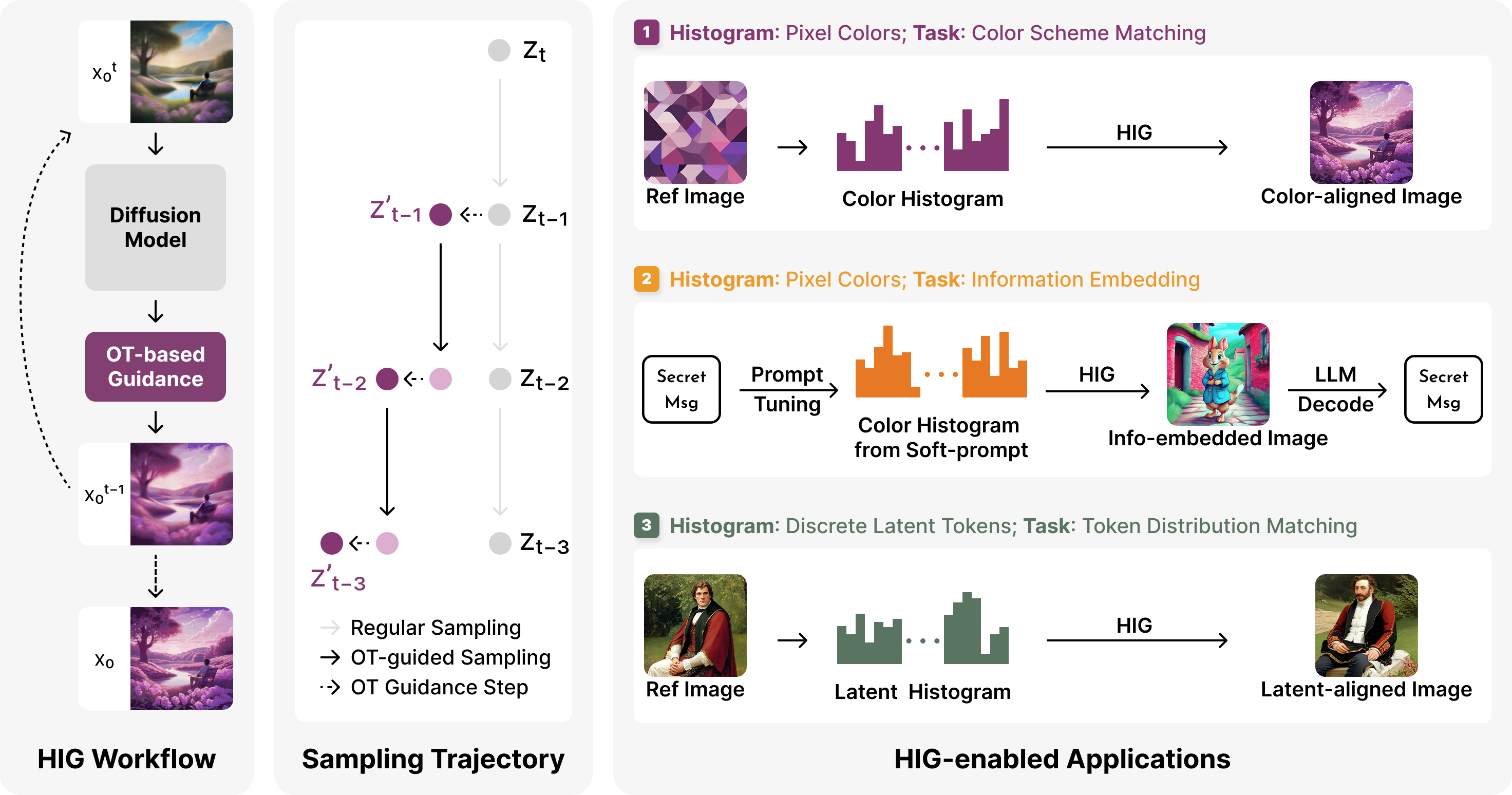
TL;DR. Controllable generation spans a spectrum of granularity: text prompts and LoRAs steer generation globally, while ControlNets anchor local structure. HIG fills the middle ground by regulating the distributional properties of an image. Given any target histogram over pixel colours, HIG drives the diffusion trajectory to match it exactly, using a minimal-cost optimal transport plan applied as inference-time guidance. It is training-free, interpretable, lightweight, and fully compatible with existing controls.
This repository is a minimal, self-contained implementation covering two applications on two backbones:
| SDXL | FLUX.1 [dev] | |
|---|---|---|
| Colour-constrained generation | ✓ | ✓ |
| Information embedding (Llama-3.1-8B) | ✓ | ✓ |
plus a demo of HIG composed with a LoRA and with a ControlNet on either backbone.
Python ≥ 3.10 and one CUDA GPU (everything here was run on a single 80 GB A100 / H100). Dependencies are managed with uv:
git clone https://github.com/MAPS-research/hig-minimal.git && cd hig-minimal
uv sync                                   # core: colour control + information embedding
uv sync --extra compose                   # + peft / opencv for the LoRA & ControlNet demo
uv sync --extra metrics                   # + CLIP / aesthetic scorers (optional)
Model weights are fetched into the Hugging Face cache by repo id:
export HF_HOME=/path/with/space          # ~60 GB for everything
./scripts/download_models.sh             # sdxl flux llm metrics
./scripts/download_models.sh --only sdxl,llm
./scripts/download_models.sh --check     # what is already cached
FLUX.1 [dev] is gated: accept its licence on Hugging Face and run hf auth login
(or set HF_TOKEN) before downloading. meta-llama/Llama-3.1-8B is gated too, so the
script pulls the NousResearch/Meta-Llama-3.1-8B mirror by default (same weights);
set LLAMA_REPO to override.
All commands below assume the environment is active (source .venv/bin/activate) or are
prefixed with uv run.
python demo/quickstart.py colour                        # colour control, SDXL
python demo/quickstart.py colour --backbone flux
python demo/quickstart.py embed --text "the sentence to hide"
python demo/quickstart.py embed --backbone flux --text "the sentence to hide"

python demo/compose.py lora                             # HIG + a style LoRA
python demo/compose.py controlnet --backbone flux       # HIG + a Canny ControlNet
quickstart.py colour generates its own reference image, then writes the unguided
result, the reference histogram applied post-hoc only, and the guided result. The last
two share a histogram bin for bin and look very different; that difference is what the
guidance buys. quickstart.py embed tunes a soft prompt for the text, generates a
carrier image whose colour histogram encodes it, and reads the text back out of the PNG.
compose.py runs the same constraint on top of a public LoRA (Papercut for SDXL,
Frosting Lane for FLUX) or a Canny ControlNet (diffusers/controlnet-canny-sdxl-1.0,
InstantX/FLUX.1-dev-Controlnet-Canny). HIG is a callback_on_step_end, so nothing on
its side changes when an adapter is added.
# colour control: match the histogram of a reference image
hig-color --prompt "an astronaut riding a horse on a rocky plain" \
          --reference sunset.png --out astronaut.png \
          --backbone sdxl --save-baseline unguided.png

# information embedding: tune, encode, decode
hig-embed train  --text-file secret.txt --out prompt.npy
hig-embed encode --embedding prompt.npy --prompt "a serene mountain lake" --out carrier.png
hig-embed decode --image carrier.png --expect-file secret.txt
Useful flags on both tools: --backbone {sdxl,flux}, --seed, --resolution, and
--noise-levels (where in the denoising process to intervene, as fractions of noise
remaining; default 0.65 0.5 0.35 0.2, empty means post-hoc only). hig-embed encode
and decode also accept --binning multi-option, a scattered-colour binning that
needs no guided steps; encode and decode must use the same one.
import numpy as np
from hig import GridBinning, HistogramGuidance, HistogramMatcher, load_backbone

pipe, adapter, defaults = load_backbone("sdxl")           # or "flux"
binning = GridBinning("rgb", levels=16)                    # 16^3 = 4096 colour bins
target  = binning.bin_histogram(reference_image).astype(np.float64)
matcher = HistogramMatcher(binning, target, seed=0)

guide = HistogramGuidance(adapter, matcher, noise_levels=[0.65, 0.5, 0.35, 0.2])
with guide:
    image = pipe(prompt="...", height=1024, width=1024,
                 callback_on_step_end=guide,
                 callback_on_step_end_tensor_inputs=["latents"], **defaults).images[0]

final = matcher(np.array(image))                           # post-hoc pass: exact, bin for bin
Any diffusers pipeline whose scheduler evaluates the model once per step works the same
way; adapter_for(pipe) picks the latent layout for the SDXL and FLUX families.
hig/
  guidance.py    HistogramGuidance: the callback_on_step_end that applies decode -> OT -> encode
  schedules.py   (a, b) coefficients per step, z0 recovery, re-noising, noise level -> step index
  tap.py         borrows the model output from scheduler.step without patching the pipeline
  adapters.py    per-backbone latent layout and the VAE round trip (SDXL, FLUX)
  pipelines.py   backbone presets: repo, dtype, VAE, scheduler, generation defaults
  binning.py     grid and multi-option colour bins, plus their transport costs
  ot.py          integer apportionment, the network-simplex OT solve, pixel reassignment
  codec.py       soft prompt <-> histogram (softmax one way, centred log the other)
  embed.py       soft-prompt tuning against Llama-3.1-8B and greedy read-back
  metrics.py     HistKL, CLIP score, aesthetic score
  cli/           hig-color and hig-embed
demo/
  quickstart.py  both applications end to end, no assets needed
  compose.py     HIG on top of a LoRA and a ControlNet
scripts/
  download_models.sh
Built on diffusers, transformers and POT. The demo uses Papercut SDXL, Frosting Lane FLUX, controlnet-canny-sdxl-1.0 and FLUX.1-dev-Controlnet-Canny. This work is supported by NYU Shanghai Center for Data Science and in part through the NYU IT High Performance Computing resources, services, and staff expertise.
The code is released under the MIT licence (see LICENSE). Model weights keep their own terms: FLUX.1 [dev] is non-commercial, Llama-3.1 is under the Llama 3.1 Community License, and each third-party LoRA and ControlNet is governed by the licence on its Hugging Face page.
@article{liu2026histogram,
  title={Histogram-constrained Image Generation},
  author={Liu, Haoming and Guo, Yuanhe and Cao, Yijia and Wan, Shenji and Wen, Hongyi},
  journal={arXiv preprint arXiv:2606.31683},
  year={2026}
}