


Reduce PAL-XFEL pump-probe X-ray diffraction runs to laser-on/off images per delay, then to ROI intensity and peak shift vs delay.
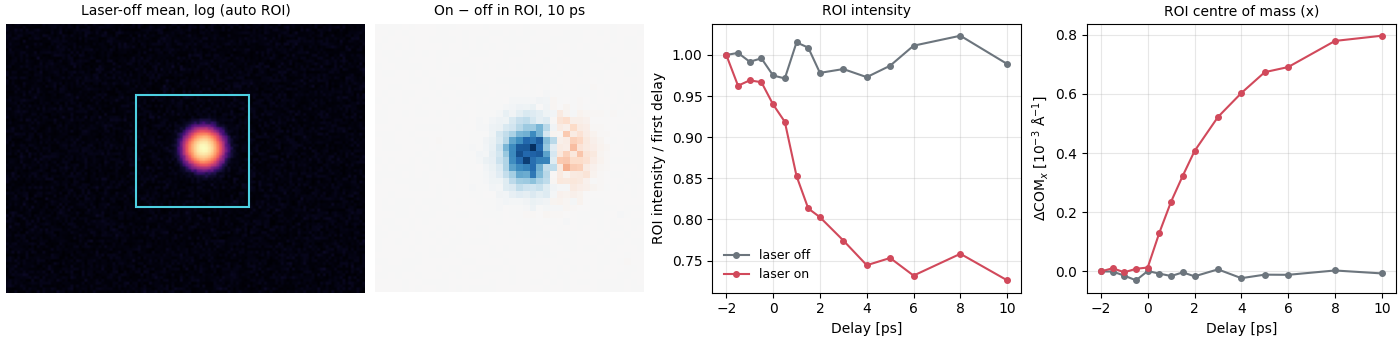
The data here are synthetic: 15 delays (-2 to 10 ps) × 2 repeat files × 100
shots of a 96×128 detector, written in the PAL-XFEL HDF5 layout the loader
reads. Simulated: one Gaussian Bragg peak, Poisson photon noise, a per-pixel
dark pedestal with read noise, shot-to-shot QBPM fluctuations that scale the
signal, alternating laser on/off shots, and for laser-on shots after t=0 a 25%
intensity drop (1.5 ps) and a 1.5-pixel peak shift (3 ps). Everything after
that is QoraFlow's own code, unchanged: scripts/make_dark.py,
scripts/integrating_main.py (auto ROI, LSB quantization, QBPM normalization,
dark subtraction, merge of the 2 repeats, per-delay averaging; LND output)
and DataAnalyzer.analyze_by_roi. Regenerate with
PYTHONPATH=src uv run python examples/readme_figure.py; all data go to a
temporary directory.
git clone https://github.com/NaNIsaac/QoraFlow.git
cd QoraFlow
uv sync --python 3.13
# point config.yaml at your raw data, then
export PYTHONPATH=src
uv run python scripts/make_dark.py
uv run python scripts/integrating_main.py
Python scripts and a small library for reducing time-resolved pump-probe X-ray diffraction data from PAL-XFEL (JUNGFRAU detector images and QBPM intensity monitor, stored as HDF5).
QoraFlow reads raw run/scan HDF5 files, splits shots into laser-on and laser-off, applies preprocessing (dark subtraction, QBPM normalization, LSB quantization), averages images per delay and writes the result as .npz and .mat files. A second script measures ROI intensity and center of mass as a function of delay and saves figures, TIFF stacks and a CSV.
It is research code used in our group; interfaces change without notice.
Requires Python 3.11-3.13 (tables has no wheels for 3.14 yet) and uv.
git clone https://github.com/NaNIsaac/QoraFlow.git
cd QoraFlow
uv sync --python 3.13
The package is not installed into the environment, so run the scripts with src on the path (shown below). Tests: uv run pytest.
Edit config.yaml in the repository root. The main fields:
runs: [109]
path:
  log_dir: ./logs
  load_dir: /path/to/raw_data/h5/type=raw   # contains run=XXX/scan=YYY/p*.h5
  analysis_dir: /path/to/analysis
  raw_dark_dir: /path/to/dark/run=171/scan=001
  save_dark_dir: ${path.analysis_dir}/dark_images/dark.npy
  output_dir: ${path.analysis_dir}/output_data
  mat_dir: ${path.analysis_dir}/mat_files
  processed_dir: ${path.analysis_dir}/processed_data
param:
  merge_num: 7          # HDF5 files (repeats) merged per dataset
  chunk_size: 100
  pump_setting: 60HZ
  hutch: eh1
  detector: jungfrau2
  xray: HX
  sdd: 1.3              # sample-detector distance [m]
  dps: 7.5e-05          # detector pixel size [m]
  beam_energy: 9        # keV
  x1: 0                 # ROI (pixels) used by analyzing_main.py
  x2: 1
  y1: 2
  y2: 3
${path.x} placeholders are resolved when the config is loaded. Then, from the repository root:
export PYTHONPATH=src
uv run python scripts/make_dark.py          # stack dark frames -> save_dark_dir (averaged when subtracted)
uv run python scripts/integrating_main.py   # raw HDF5 -> processed .npz / .mat
uv run python scripts/analyzing_main.py     # ROI intensity and COM vs delay
integrating_main.py writes one file per preprocessor to
processed_dir/run=XXX/scan=YYY/: run=XXXX_scan=YYYY_LND.npz (LSB
quantization, QBPM normalization, dark subtraction) and ..._raw.npz, each with
pon, poff and delay arrays (pon_delay/poff_delay if the two differ),
plus .mat files per array in mat_dir. The QBPM-normalization ROI is picked
automatically around the brightest region of the middle file.
analyzing_main.py opens a Qt window to select the ROI and reads scan 1 only,
from run=XXXX_scan=0001_LND.npz (change suffix in the script to raw for
the unprocessed images).
The raw files follow the PAL-XFEL layout:
p0110.h5
├── detector/eh1/jungfrau2/image
├── metadata
├── qbpm/eh1/qbpm1
├── oh, oxc, pd
PalXFELLoader reads the frames from image/block0_values and their
timestamps from image/block0_items, sums qbpm1/waveforms.ch1..4/block0_values
per shot, and takes metadata (a pandas table indexed by timestamp) for the
laser-on flag timestamp_info.RATE_<xray>_<pump_setting> and the delay
(th_value, else delay_value; one delay per file). Shots are matched across
the three by timestamp.
To pick an ROI interactively (Qt window; --roi prints the selected rectangle):
uv run python -m QoraFlow.gui processed 109 --roi --log        # from run=0109_scan=0001_LND.npz (--suffix raw)
uv run python -m QoraFlow.gui raw 109 1 110 --roi --vmax 500 # from raw run/scan/p-filesrc/QoraFlow/
integrator/ HDF5 loader (PalXFELLoader), integration, npz/mat savers
preprocessor/ dark subtraction, QBPM normalization, LSB quantization
analyzer/ ROI intensity / center-of-mass analysis and figures
gui/ Qt ROI selector
config/ YAML config with pydantic validation
datacheck/ raw-file size checks and MAD outlier detection
scripts/ entry-point scripts (run from repo root)
notebooks/ exploratory analysis notebooks
examples/ README figure generator (synthetic data)
QoraFlow is a refactor of the earlier XFEL_data codebase written by Kim Jooheun (@paulpeterkim), 2021-2023.
See CITATION.cff.
MIT, see LICENSE.md.