


Phase retrieval for coherent diffraction imaging in JAX: pass a diffraction intensity array, get the complex object back.
In coherent diffraction imaging (CDI) the detector records only the intensity of the far-field diffraction pattern; the phase is lost. QoraPhase recovers the complex object (amplitude and phase) from a measured 2D or 3D pattern with the standard iterative algorithms (ER, HIO, RAAR, shrinkwrap), on CPU or GPU. It is for people who already have a centred diffraction pattern as an array and want a reconstruction they can check.
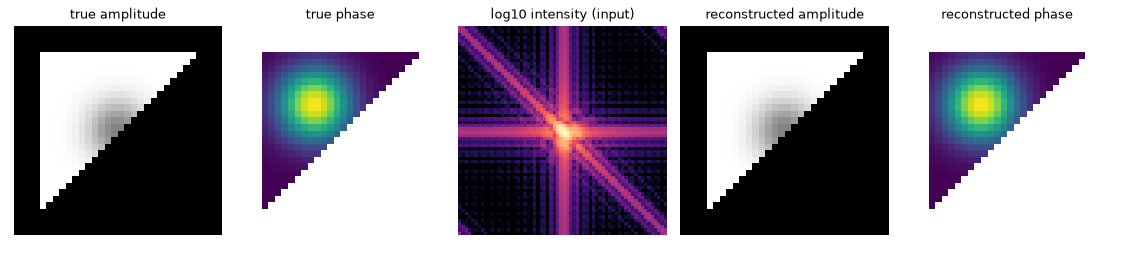
A 64×64 simulated object, its noiseless intensity, and the best of 8 random
starts from qp.reconstruct(intensity, starts=8) with no support given (it is
derived from the autocorrelation and shrinkwrapped). Relative error against the
true object: 7.9e-7. Script: examples/readme_figure.py.
Requires Python 3.12+.
pip install qoraphaseimport numpy as np
import qoraphase as qp
intensity = np.load("pattern.npy") # centred 2D or 3D diffraction intensity
result = qp.reconstruct(intensity) # pass support=... if you have one
result.plot() # result.amplitude, result.phaseQoraPhase does not read files: you bring a numpy or jax array. Iterative
algorithms (ER, HIO, RAAR), shrinkwrap, detwinning and multi-start are
composable pieces of a recipe, and multi-start runs are vectorised with vmap.
| Origin | Every public array is center-origin: index n // 2 is q=0. ifftshift is internal; never call it yourself. |
intensity |
A measured intensity, not an amplitude. Internally sqrt(clip(intensity, 0)). |
mask |
True marks an unusable pixel (beamstop, hot, saturated). Masked pixels are left unconstrained — never forced to zero. |
support |
True is inside the object. Omit it and an autocorrelation support is derived (loose; pass a real one when you have it). |
Code order is execution order.
problem = qp.CDI(intensity=intensity, support=support, mask=mask)

recipe = qp.Recipe(
    qp.repeat(10, qp.RAAR(50, beta=0.9), qp.Shrinkwrap()),
    qp.ER(200),
)

result = problem.reconstruct(recipe)
The first positional argument of an algorithm is always its iteration count.
qp.detwin(...) runs its body against a support cut in half at the object's
centre of mass, then restores the full support. That cut is not centrosymmetric,
so it fits only one of the two conjugate solutions and biases the run into a
branch. The default recipe runs one detwin pass before shrinkwrap starts. It
helps when the support is symmetric and the run would otherwise stall; a support
with the right shape helps more.
qp.Shrinkwrap(threshold, sigma, method) takes method="max" (classic, relative
to the peak amplitude) or method="rms" (relative to the rms inside the current
support, less easily thrown off by a hot pixel). The thresholds are on different
scales: the classic "max" value is 0.2, PyNX uses 0.28 for "rms".
The defaults are 0.3, 1.0 rather than the classic 0.2, 2.0, because only
those converged from an autocorrelation support on the synthetic test objects.
These two numbers are the first thing to re-tune on a real dataset.
For a support with awkward symmetry, several random starts are often the difference between converging and not.
ensemble = problem.reconstruct(recipe, starts=32, batch=4)
best = ensemble.best
vmap holds every start in memory at once. batch chunks that: lower it if a
large 3D volume runs out of GPU memory.
Measured on the README object above (64×64, default recipe, no support), CPU only. "Converged" counts runs whose final Fourier error is below 1e-3; on this object the final errors fall either below 1e-5 or above 6e-3.
CPU: Intel64 Family 6 Model 158 Stepping 10, GenuineIntel | JAX 0.11.1 (cpu) | Python 3.14.7
| starts | first call (incl. compile) | vmap, warm | loop of starts=1, warm | converged (vmap) | converged (loop) |
|---|---|---|---|---|---|
| 1 | 2.34 s | 0.05 s | 0.05 s | 1/1 | 1/1 |
| 8 | 2.19 s | 0.36 s | 0.50 s | 3/8 | 2/8 |
| 32 | 3.71 s | 1.82 s | 2.18 s | 12/32 | 9/32 |
Roughly a third of the starts converge on this object (21 of 64 across the two
32-start columns), so one start fails more often than not, while 8 starts
contained at least one success in both columns. On CPU, vmap beat a Python
loop of single starts at 8 and 32 starts, by a margin (17–28% here) that moves
between runs. Each new starts value costs a first call of 2–4 s, mostly
compilation.
Regenerate with python examples/bench_multistart.py.
Algorithms never name an FFT, so the physics is replaceable without touching them:
qp.CDI(intensity, support=support, model=MyPropagator())A model needs forward / adjoint and should be unitary. A wrong model fails
silently: it can fit the data perfectly and return the wrong object. See
tests/test_forward_model.py.
Check the measurement against the assumptions the library makes about it:
print(qp.diagnose(intensity, mask=mask, support=support))It reports the centring offset two ways (brightest pixel, and Friedel symmetry, which resolves half a pixel and works on patterns with no dominant peak), how much of the array the autocorrelation fills, the negative and masked fractions, and warns about each. An off-centre pattern is the most costly and least visible failure.
examples/diagnose.py does the same from the command line, then reconstructs
and reports whether independent starts agree:
python examples/diagnose.py scan.npz --key intensity --support sup.npy --starts 8
A low Fourier error says a run fits the data. Agreement between starts, after alignment, is what says the answer is determined.
A reconstruction is determined only up to a global phase, a translation, and a conjugate flip. No iteration can remove those — they are exact symmetries of the constraints — so they are resolved afterwards:
aligned = ensemble.align()      # every run brought onto the best one
mean = ensemble.average()       # coherent mean of the aligned runs
Never average runs without aligning them (average() aligns for you). Each
run carries its own global phase, so a raw mean interferes destructively and
loses amplitude.
align() adopts whichever conjugate branch the best run is in; that is a
convention, not a statement about which branch is real. conj(obj(-r))
reproduces the measured intensity exactly, so only the support you supply breaks
the tie: a reflected support converges just as cleanly on the mirrored object.
If the twin branch matters, break the symmetry during the run with qp.detwin.
Alignment works to whole pixels. result.phase keeps any linear phase ramp from
the measurement geometry; QoraPhase does not remove it.
- No phase-ramp removal, no sub-pixel alignment, no clustering, no PRTF.
- No positivity/reality constraint — the object is complex here.
- No file I/O, no BCDI geometry, no NUFFT, no strain, no autodiff optimisers.
uv sync --all-groups
uv run pytest