
A small service per machine that frees GPUs on request and tells who holds what. Before a model
loads, its caller asks GPU-Orc to clear the cards the model will use; GPU-Orc asks the services that
sit there to let go, through their own interfaces. It never kills a process from outside: the hardest
step is a service's own force, and only where the config allows it.
It loads nothing, plans nothing and is no model server. One place per machine knows how to free its cards, instead of every caller carrying its own copy of that logic.
- Consumers are the services that hold GPUs. Each has a type, one implementation per protocol:
gpu-release: a service with the common release API of the STT-Suite and the TTS-Suite (GET /gpu/holders,POST /gpu/release). While an item is busy (a transcription, a reading) the service answers "busy"; GPU-Orc waits up tobusy_wait_s, then has the service force it ifforce_after_waitis set. The service ends the process or container itself and saysreleasedonly once it is gone.llama-swap: a model server. GPU-Orc reads which cards each model uses (CUDA_VISIBLE_DEVICESin the model'senv) and which models are persistent (groups withpersistent: true) from llama-swap's own config.
- Checked, not believed: after a release GPU-Orc asks the service again and measures the card
memory with nvidia-smi, until
verify_timeout_s. An item still reported, or memory that did not go down, isnot_freed. - Who holds what comes from the services themselves. nvidia-smi only gives total and used memory per card, which also works under WSL2, where it lists no processes. Memory nobody reports is shown, never touched.
- Requests to free are handled one after another; within one request all consumers are asked at
the same time. Every request ends at the latest
free_timeout_safter it arrived, waiting in the queue included.
| Endpoint | Purpose |
|---|---|
GET /health |
version, free_timeout_s and the HTTP timeout callers should use |
GET /loading |
which big models are loading right now, for those who want to start something on a card |
GET /status |
per GPU: memory, holders, unattributed memory; the queue; consumers that could not report |
POST /free |
free GPUs: {"gpus": [0, "GPU-…"] | "all", ...} or {"model": "<name>", ...} |
POST /free takes exactly one of two forms, plus reason (required), keep and dry_run:
gpus: everything on these cards goes, main models of a model server included, even in the middle of an answer.keepprotects ("llama-swap"or"llama-swap:<model>").model: the model about to be loaded.- If it already runs, GPU-Orc answers
already_runningat once, without queueing. - Otherwise services on its cards and the server's persistent models there go. The server swaps its other models itself.
- If it already runs, GPU-Orc answers
The full description is in docs/interface.md; the suites' common release API in docs/release-api.md.
Requests over loopback need no token. From other machines they need Authorization: Bearer <token>;
GPU-Orc refuses to start on a non-loopback address without a token file.
Needs Python 3.12 with venv (Debian/Ubuntu: python3-venv) and nvidia-smi.
deploy/install.sh                       # venv in ~/.local/share/gpu-orc, user unit, first config
$EDITOR ~/.config/gpu-orc/config.yaml   # the consumers of this machine
systemctl --user enable --now gpu-orc
# or, to run at boot without a login:
sudo deploy/switch-to-system-unit.sh
The system unit comes with a polkit rule: its user restarts it without a password
(systemctl restart gpu-orc@<user>), for instance after changing the config. It needs polkit
(Debian/Ubuntu: polkitd); without it the script stops before changing anything.
The config is described in deploy/config.example.yaml.
python3 -m venv .venv && .venv/bin/pip install -e ".[dev]"
.venv/bin/python -m pytest
.venv/bin/ruff check src tests && .venv/bin/mypy src tests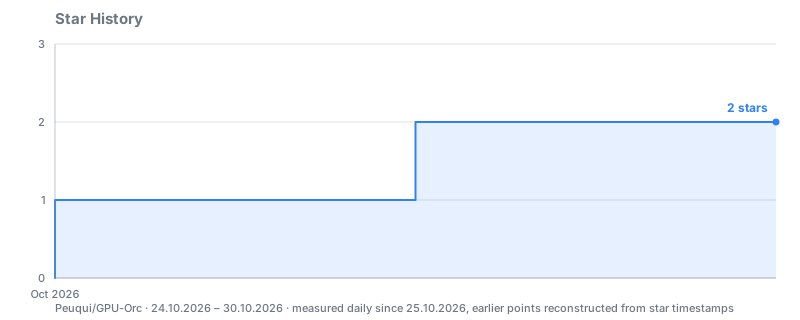
Recorded daily in Peuqui/Traffic, together with views and clones. GitHub restricted the stargazer API to repo admins on 2026-06-30, so external chart services now need a token with write access.
PolyForm Noncommercial 1.0.0: free to download and use for any noncommercial purpose; commercial use needs the author's permission.