


This is an extended fork of dstotijn/hetty. Upstream Hetty is a Burp-Suite-style HTTP intercepting proxy. This fork keeps all of that and grows it into a single-binary offensive platform: it folds in an attack-surface engine (Sn1per / reNgine / Osmedeus style), native recon, a nuclei-compatible template scanner, continuous monitoring, distributed fan-out scanning, pluggable cloud save backends, optional Metasploit auto-exploitation, an AI analyst, and an MCP server — all dependency-light Go, no Burp/Kali license required.
Hetty is an HTTP toolkit for security research. It started as an open-source alternative to commercial software like Burp Suite Pro, and this fork extends it into a full offensive-security workbench for the infosec and bug-bounty community — proxy and manual tooling on one side, automated attack-surface discovery and scanning on the other, with everything correlated into a single project database.
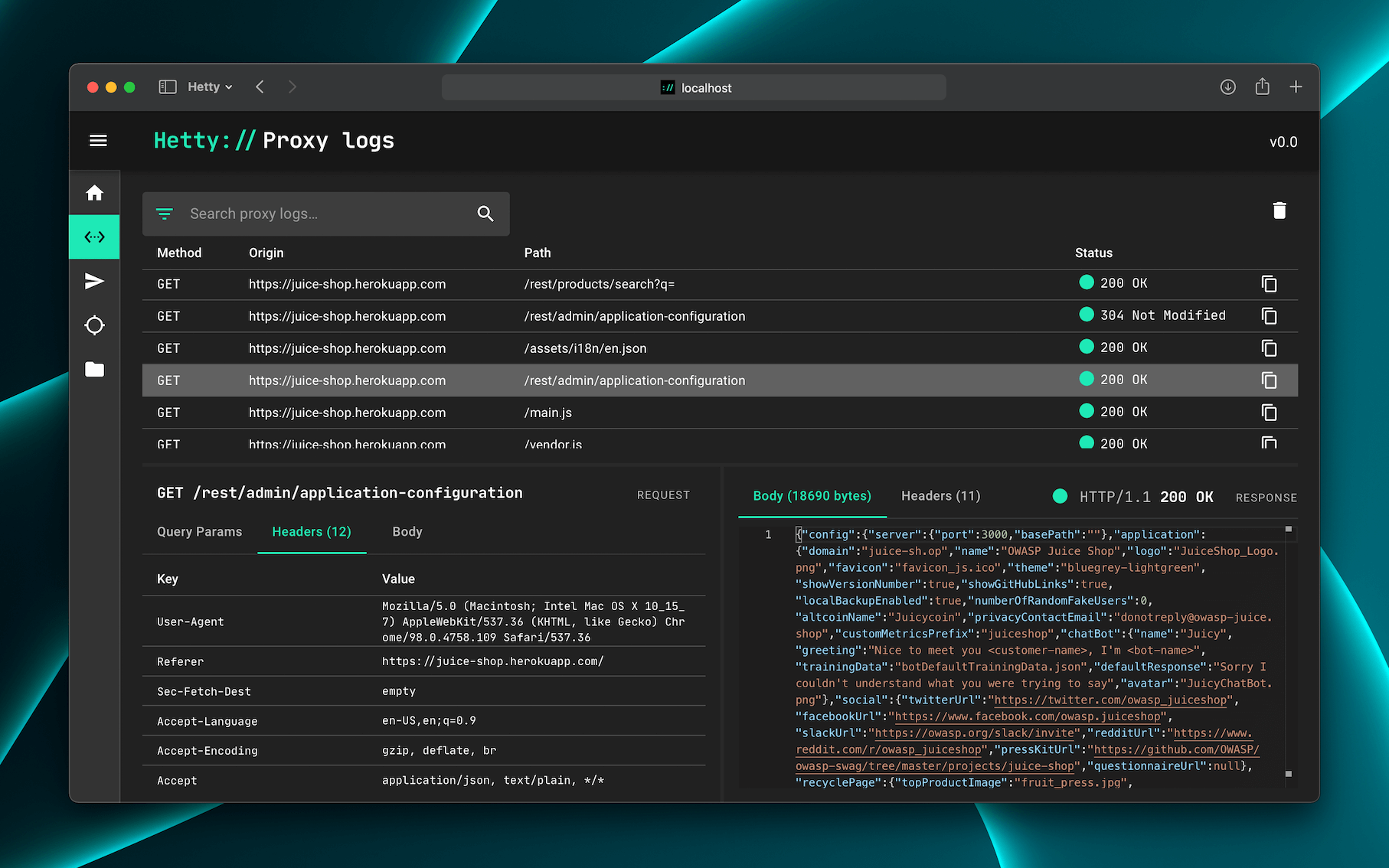
Everything below is available from the web dashboard and via a JSON/REST API mounted alongside the GraphQL endpoint. Tools persist their state to the project database and survive restarts.
- Machine-in-the-middle (MITM) HTTP proxy, with logs and advanced search
- HTTP client / Sender (repeater) for manually creating, editing and replaying proxied requests
- Intercept requests and responses for manual review (edit, send/receive, cancel)
- Scope support and project-based database storage to keep work organized
- Match & Replace rules that rewrite proxied requests/responses
- Macros and a WebSocket Repeater for composing and replaying traffic
- WebSocket interception — the proxy parses and logs WS frames; history is browsable in the dashboard
- Request annotations, rate limiting, upstream-proxy chaining, and "Send to" tool routing (Scanner / Intruder / Authz from any log row)
- Active & passive vulnerability scanner with a built-in check library (reflected XSS, error-based SQLi, time-based OS command injection, path traversal/LFI, SSTI, CRLF/header injection, open redirect, and out-of-band blind detection — plus passive checks for missing security headers, insecure cookies, banner and verbose-error disclosure, and directory listings)
- Templated scanner — a nuclei-compatible YAML engine (status / word / regex matchers) so Hetty can consume the community template ecosystem
- Intruder — automated payload attacks (sniper, battering ram, pitchfork, cluster bomb) with payload processors and response grep match/extract
- Crawler/spider (static) plus a JS-rendering crawler (headless Chrome) for SPA endpoints, with one-click crawl-and-audit
- Out-of-band (OOB) collaborator for blind detection, over HTTP and (optionally) DNS
- Metasploit driver (optional) — auto-exploitation via an external MSF RPC
endpoint, gated behind explicit flags and
nuke/--exploitmode
- Attack-surface sweeps — a scan-mode orchestrator (
recon/web/full/nuke) that chains recon, port, TLS, WAF, web-scan, screenshot, vuln-match and (optionally) Metasploit into one command, with persistent workspaces - Native recon — subdomain enumeration from Certificate Transparency logs (crt.sh), live-host resolution, and WhatWeb-style technology fingerprinting
- Native port scanner — TCP connect scan with banner grabbing and service ID (no nmap dependency)
- Native TLS/SSL analyzer — protocol-version probing and weak-cert/cipher flags (no sslscan/testssl)
- WAF fingerprinting (wafw00f-style) against a signature database
- Vulnerability matching — maps product/version banners to known vulns (offline searchsploit/vulners style) to prioritize and feed auto-exploitation
- OSINT — Shodan host lookups (key-gated)
- Screenshots — headless-Chrome PNG capture (gowitness/eyewitness style) to build a gallery of discovered live hosts
- Unified asset graph — domains, hosts, URLs, services and findings, each with first-/last-seen timestamps, observing sources, attributes and parent links, correlated into one queryable graph that grows over time
- Content discovery — recursive forced browsing with bundled wordlists and soft-404 calibration
- Site map — host→path tree aggregating proxy, spider and discovery traffic with observed parameters and detected technology
- JavaScript recon — passive mining of proxied JS for endpoints and leaked secrets (LinkFinder / SecretFinder style), backed by a curated secrets DB
- Parameter discovery — Param Miner-style hidden-parameter brute forcing (query/body/header) with reflection and behavior-change detection
- GraphQL tooling — introspection, schema browsing, generated query skeletons
- JWT editor — re-sign edited claims, forge
alg:none, HS/RS key confusion, and weak-secret brute force - Request smuggling probe — timing-based CL.TE / TE.CL desync detection
- Authorization tester (Autorize-style) — replays a request under other identities to find IDOR / BOLA / broken access control
- Auth profiles & session handling — named identities (headers, cookies, bearer, CSRF-token macro) and login macros (session flows) applied by the authorization tester, scanner and intruder so automated requests run authenticated
- Decoder (URL, Base64, hex, HTML, gzip/zlib, JWT, MD5/SHA hashing, smart decode), Comparer (word/byte diff), Sequencer (token entropy analysis)
- PoC generators — auto-submitting CSRF pages and clickjacking overlays (Burp CSRF-PoC / Clickbandit style)
- Workflows — chain tools into named, repeatable engagement sequences (recon → probe → scan), with prebuilt chains and user-defined ones aggregating into a single report
- Continuous monitoring — schedules re-run a probe on a timer, diff against the previous snapshot, and alert on change (new subdomain, newly open port, freshly vulnerable service) with auto-saved results
- Distributed scanning — a controller fans a target list out across registered Hetty worker instances and aggregates results (Axiom-style horizontal scaling, no cloud SDK)
- External-tool framework — runs the classic Kali/Sn1per arsenal (nuclei,
trivy, ffuf, etc.) when present on
PATH, building argv safely with no shell, capturing live output in the GUI — the hybrid escape hatch over the native fast path - Save / Storage backends (vault) — write reports, exports and monitoring snapshots to a local folder, network share (UNC), S3-compatible storage, Azure Blob, Google Drive or Box, all implemented with the standard library only
- AI analyst (optional) — an LLM assistant that triages scanner findings
(false-positive scoring), suggests payloads, and drafts proof-of-concept
reports; enable with
--ai-keyorANTHROPIC_API_KEY - MCP server —
hetty mcpexposes Hetty's engines as Model Context Protocol tools over stdio, so an AI agent (Claude Desktop, Claude Code) can drive scans, recon, param mining, GraphQL introspection, smuggling probes and more - Extension ecosystem — JavaScript extensions with request/response hooks, custom active/passive scan checks, and registered custom actions
- Findings export — scanner issues as a standalone HTML or Markdown report
- Headless / CI scanning —
hetty scanruns a crawl-and-audit from the CLI and fails the build on findings at or above a chosen severity - JSON/REST API exposing every tool for automation
Every tool is reachable from the web dashboard and over the JSON/REST API mounted alongside the GraphQL endpoint:
| Tool | Endpoint(s) |
|---|---|
| Scanner | POST /api/scanner/scan, GET/DELETE /api/scanner/issues, GET /api/scanner/checks |
| Templated scanner | GET /api/template, POST /api/template/run |
| Crawl & audit | POST /api/spider/crawl, POST /api/scanner/crawl-scan |
| JS-rendering crawler | POST /api/browser/crawl |
| Intruder | POST /api/intruder/positions, POST /api/intruder/run |
| Decoder | GET /api/decoder/codecs, POST /api/decoder, POST /api/decoder/smart |
| Comparer | POST /api/comparer |
| Sequencer | POST /api/sequencer |
| Match & Replace | GET/PUT /api/rules |
| Macros | GET/PUT/DELETE /api/macros, POST /api/macros/run |
| WS Repeater | POST /api/wsrepeater |
| PoC generators | POST /api/poc/csrf, POST /api/poc/clickjacking |
| Findings export | GET /api/scanner/report?format=html|md |
| Parameter discovery | POST /api/paramminer |
| GraphQL | POST /api/gql/introspect |
| Request smuggling | POST /api/smuggle |
| WebSocket history | GET /api/websocket/connections, GET /api/websocket/messages, DELETE /api/websocket |
| AI analyst | GET /api/ai/status, POST /api/ai/triage, POST /api/ai/payloads, POST /api/ai/report |
| Authorization tester | POST /api/authz/analyze |
| Auth profiles & sessions | GET/PUT /api/session/profiles, DELETE /api/session/profiles?name=… |
| Content discovery | POST /api/discovery |
| Wordlists | GET /api/wordlists |
| Site map | GET/DELETE /api/sitemap, POST /api/sitemap/ingest |
| JWT editor | POST /api/jwt/parse, /api/jwt/sign, /api/jwt/alg-none, /api/jwt/brute |
| Annotations | GET/PUT /api/annotations, DELETE /api/annotations?id=… |
| Extensions | GET /api/extensions, POST /api/extensions/reload, GET /api/extensions/actions, POST /api/extensions/actions/run |
| Collaborator | POST /api/collab/token, GET /api/collab/interactions?token=… |
| Attack surface (ASM) | POST /api/asm/run, GET /api/asm/workspace, GET/PUT/DELETE /api/asm/workspaces |
| Recon | POST /api/recon/subdomains, POST /api/recon/fingerprint |
| Port scan | POST /api/portscan |
| TLS scan | POST /api/tlsscan |
| WAF detect | POST /api/wafdetect |
| OSINT | POST /api/osint/shodan |
| Screenshots | POST /api/screenshot |
| Asset graph | GET /api/assets, GET /api/assets/interesting, GET /api/assets/related, GET /api/assets/stats |
| Workflows | GET/PUT/DELETE /api/workflows, POST /api/workflows/run |
| Monitoring | GET/PUT/DELETE /api/monitor/schedules, POST /api/monitor/run, GET /api/monitor/diffs |
| Distributed | GET/PUT/DELETE /api/cluster/workers, POST /api/cluster/run |
| External tools | GET /api/exttools, POST /api/exttools/run, GET /api/exttools/job, POST /api/exttools/stop |
| Save / Storage (vault) | GET/PUT/DELETE /api/vault/destinations, POST /api/vault/save |
| Metasploit | GET /api/msf/status |
The scanner persists issues per project, de-duplicating by fingerprint. Passive
checks also run automatically on all proxied traffic (including JavaScript recon
that mines proxied JS for endpoints and secrets). The collaborator records
out-of-band callbacks at /oob/<token> and is used by the scanner's blind
detection check; pass --dns-addr :53 --dns-domain oob.example.com to also
record DNS pingbacks for a delegated domain.
The authorization tester replays a request under stored auth profiles (and an unauthenticated variant) and classifies each as bypassed / enforced / ambiguous by comparing responses to the privileged baseline. Profiles are managed under Auth Profiles and may carry a CSRF-token macro. Proxy-log rows have Send to Scanner / Intruder / Authz actions, and the site map organizes everything Hetty has seen into a per-host path tree.
The ASM engine chains the native recon, port, TLS, WAF, web-scan, screenshot and vuln-match engines into one-command sweeps over a persistent workspace. Run it headless from the CLI:
$ hetty sweep --targets example.com,api.example.com --mode fullModes escalate in depth: recon (discovery only) → web (recon + web scan) →
full (everything passive/active and safe) → nuke (adds Metasploit
auto-exploitation; requires --exploit and --msf-url). --full-ports widens
the port scan from the top 100 to ports 1–1024.
Monitoring turns the point-in-time tools into a watch: a schedule re-runs a probe
against a target on a timer, diffs the result against the previous snapshot, and
surfaces "what's new since last time" — a new subdomain, a newly open port, a
freshly vulnerable service. Results auto-save to the project (and to any
configured vault destination). Manage schedules under Monitoring or via
/api/monitor/schedules; a background scheduler runs them while the server is up.
For large target lists, register additional Hetty instances as workers (each just
a Hetty exposing its REST API, optionally protected with --auth-token). The
controller fans the targets out across the pool, runs a scan kind on each, and
aggregates the results — Axiom-style horizontal scaling with no cloud-provider
SDK. Provision workers however you like; the controller only needs their URLs.
Configure under Distributed or via /api/cluster/workers and /api/cluster/run.
When the classic command-line tools (nuclei, trivy, ffuf, and friends) are
installed on PATH, the External Tools page runs them for you: Hetty detects
availability, builds argv safely (no shell, so no metacharacter injection),
executes in the background, and streams live output into the GUI. Native engines
are the fast path; these wrappers add depth when the real tools are present.
Reports, exports and monitoring snapshots can be written to a pluggable set of
destinations: a local folder, a network share (UNC path), S3-compatible object
storage, Azure Blob Storage, Google Drive or Box. Every backend is implemented
with the standard library only (raw HTTP + crypto), so Hetty stays a single
dependency-light binary. Configure under Save / Storage or via
/api/vault/destinations.
hetty mcp runs a Model Context Protocol server over stdio, exposing Hetty's
engines as tools an AI agent can call by natural language: scan_url,
discover_content, mine_parameters, graphql_introspect, smuggle_probe,
recon_subdomains, fingerprint, run_templates, and decode. Point Claude
Desktop, Claude Code, or any MCP client at it to drive Hetty conversationally.
Run a scan from the command line without the proxy or web UI — useful in CI to gate a build on newly introduced vulnerabilities:
$ hetty scan --target https://staging.example.com/ --crawl --fail-on high --format md --output report.mdIt crawls the target (with --crawl), actively scans every discovered page,
writes a report (md, html or json), and exits with code 2 if any
finding is at or above the --fail-on severity — so a CI job fails when a
high/critical issue appears. --rate throttles requests to stay polite.
The dashboard packs a lot of tools, so the sidebar supports modes that show only a relevant subset. Built-in modes: Everything, Recon, Web app, Network, Platform, and Minimal — and you can define your own custom modes (persisted in the browser). Projects, Settings and the in-app Guide are always visible.
Cross-platform binaries are built with GoReleaser
(.goreleaser.yaml). The release hooks build and embed the admin frontend, then
compile static binaries for Linux, macOS and Windows (amd64/arm64):
$ goreleaser build --snapshot --clean   # local test build
$ goreleaser release --clean # tagged releaseJavaScript extensions are loaded from ~/.hetty/extensions. They interact with
Hetty through the hetty host API to hook proxied traffic, send requests,
register custom scan checks, and expose custom actions. See
examples/extensions for working samples and the full
API reference.
Because this is a fork, the upstream package managers (brew, snap, scoop)
install vanilla Hetty without the tooling above. To get this build, compile
from source.
Requirements: Go 1.25+ and Node/Yarn (to build the embedded admin frontend).
git clone https://github.com/anthonyonazure/hetty.git
cd hetty
make build          # builds the admin UI, embeds it, then `go build ./cmd/hetty`
./hetty             # run it
The default branch carries the full fork (everything documented above), so a
plain clone or a GitHub fork gets all of it. The pentest-tooling branch is the
development branch and mirrors the same work.
make build runs yarn install && yarn run export in admin/, moves the static
export into cmd/hetty/admin, and compiles a single self-contained binary
(CGO_ENABLED=0). Use make clean to reset build artifacts.
Once built, start Hetty via:
hettyThen open the admin interface (default http://localhost:8080), and configure
your browser/system to use Hetty as its HTTP proxy. The first run creates a root
CA certificate at ~/.hetty/hetty_cert.pem — trust it so HTTPS interception
works.
To list all available options, run hetty --help:
Usage:
    hetty [flags] [subcommand] [flags]

Runs an HTTP server with (MITM) proxy, GraphQL service, and a web based admin interface.

Options:
    --cert            Path to root CA certificate. Creates file if it doesn't exist. (Default: "~/.hetty/hetty_cert.pem")
    --key             Path to root CA private key. Creates file if it doesn't exist. (Default: "~/.hetty/hetty_key.pem")
    --db              Database file path. Creates file if it doesn't exist. (Default: "~/.hetty/hetty.db")
    --addr            TCP address to listen on, in the form "host:port". (Default: ":8080")
    --chrome          Launch Chrome with proxy settings applied and certificate errors ignored. (Default: false)
    --rate            Global request-rate cap (req/sec) for scanner, intruder and spider. 0 = unthrottled.
    --upstream-proxy  Route outbound traffic through an upstream http://, https:// or socks5:// proxy.
    --auth-token      Require this token (Basic password, Bearer, or X-Hetty-Token) for the UI + API. Recommended off-localhost.
    --dns-addr        UDP address for the OOB DNS collaborator listener (e.g. ":53"). Disabled when empty.
    --dns-domain      Base domain delegated to the DNS collaborator (e.g. "oob.example.com").
    --ai-key          Anthropic API key enabling the AI analyst. Falls back to ANTHROPIC_API_KEY.
    --ai-model        Model for the AI analyst (default: claude-opus-4-8).
    --shodan-key      Shodan API key for OSINT host lookups. Falls back to SHODAN_API_KEY.
    --msf-url         Metasploit RPC endpoint for auto-exploitation (e.g. https://127.0.0.1:55553/api/). Disabled when empty.
    --msf-user        Metasploit RPC username. (Default: "msf")
    --msf-pass        Metasploit RPC password.
    --msf-insecure    Skip TLS verification for the Metasploit RPC endpoint. (Default: true)
    --verbose         Enable verbose logging.
    --json            Encode logs as JSON, instead of pretty/human readable output.
    --version, -v     Output version.
    --help, -h        Output this usage text.

Subcommands:
    - cert    Certificate management
    - scan    Run a headless scan against a target and emit a report (CI-friendly)
    - sweep   Run a headless attack-surface sweep (recon/web/full/nuke) and print a report
    - mcp     Run an MCP (Model Context Protocol) server exposing Hetty's tools over stdio

Run `hetty <subcommand> --help` for subcommand specific usage instructions.

Visit https://hetty.xyz to learn more about the upstream project.
⚠️ Authorization. This fork ships active scanning, exploitation and OOB collaborator features. Only point them at systems you own or are explicitly authorized to test. When binding to a non-localhost address, set--auth-token.
📖 The upstream proxy/UI docs at hetty.xyz/docs cover the core. Fork-specific tooling is documented in-app under the Guide tab.
- Hetty is created by David Stotijn (dstotijn) and the Hetty contributors — this is a fork that builds on their excellent foundation. If you find the core useful, sponsor the upstream author.
- Thanks to the Hacker101 community on Discord for the encouragement and early feedback.
- The font used in the logo and admin interface is JetBrains Mono.
© 2019–2025 Hetty Software, and fork contributors.