


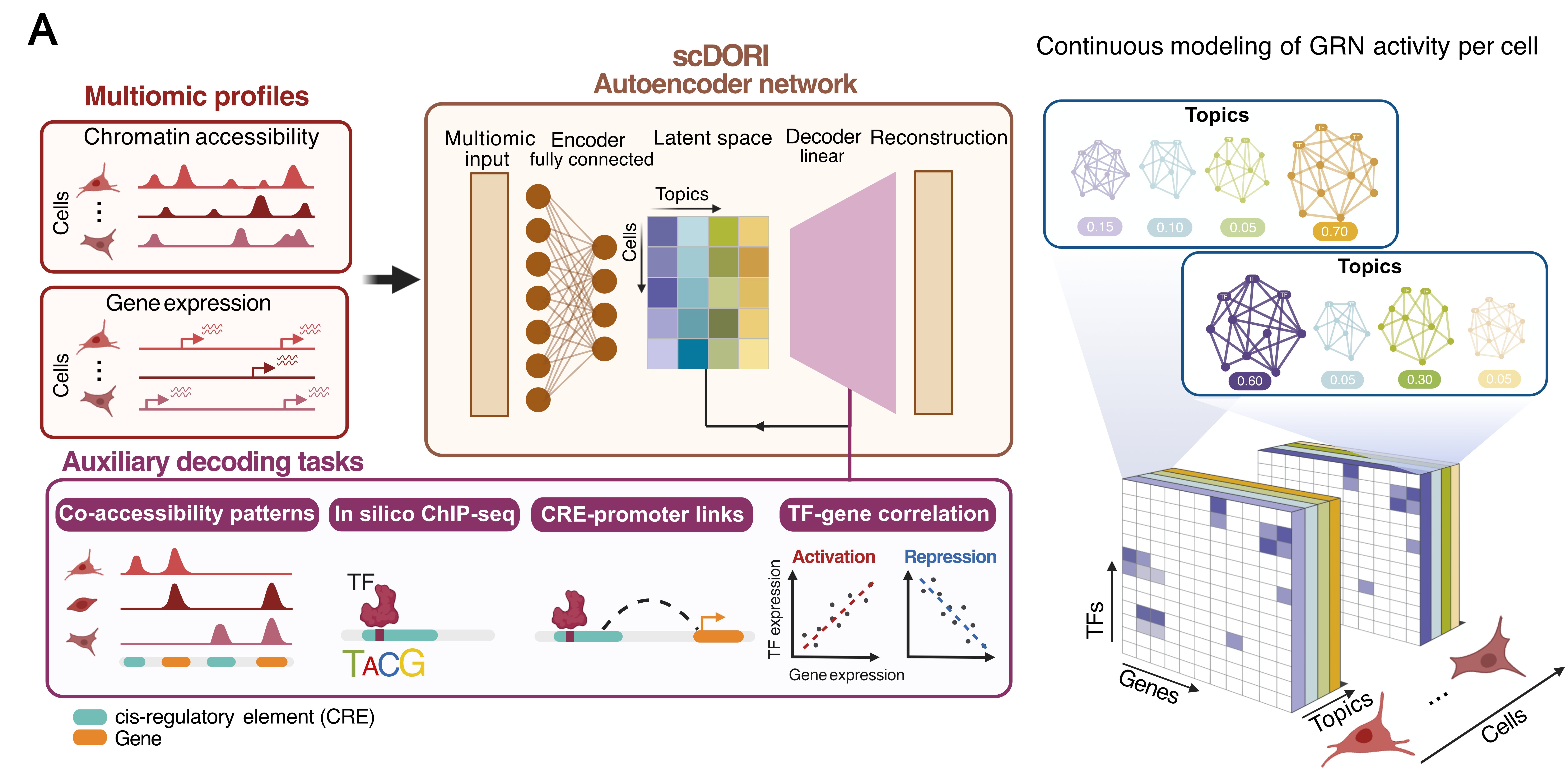
scDORI is a deep learning model for single-cell multiome data (RNA + ATAC in same cell) that infers enhancer-mediated gene regulatory networks (eGRNs). By combining an encoder–decoder approach with mechanistic constraints (enhancer–gene links, TF binding logic), scDORI learns topics that group co-accessible peaks, their cis-linked genes and upstream activator and repressor TFs – all while scaling to large datasets via mini-batches.
scDORI is described in Saraswat et al., Nature 2026.
- 🔄 Unified approach: a single model for dimensionality reduction + eGRN inference
- 🧠 Learns topics that represent cell-state-specific regulatory programs
- 🧬Continuous eGRN modelling : each cell is a mixture of topics, allowing the study of changes in GRNs. No need for predefined clusters
- 🧰 Scalable to large datasets via mini-batch training
- Faster phase 2: the fixed phase-1 calculations are cached instead of being repeated for every minibatch: 10.9× faster phase-2 training in a matched single-cell benchmark (timings).
- Regularisation now works: in v1.0.0 the L1 and L2 penalties were computed on detached tensors, so they never affected training.
- A clearer TF-expression rule: a TF is compared with other TFs in a topic and with its own expression in other topics, and it needs measured RNA in that topic's top cells.
- Review before continuing: check topic use, cell maps and gene and TF programs after phase 1.
- Clearer notebooks: the same three notebooks and one shared config, with fuller explanations of how to read each result.
Upgrading from v1.0.0: fitted results differ, so refit your data rather than comparing networks across versions. The changelog lists the new defaults and how to restore them.
scDORI expects single-cell multiome data with the following inputs:
RNA: an AnnData.h5adobject with cells × genes expression matrixATAC: an AnnData.h5adobject with cells × peaks accessibility matrix- Name peaks as
chr:start-end(for examplechr1:1000-1200); preprocessing creates the coordinate columns from these names.
- Name peaks as
These datasets must be paired — i.e., RNA and ATAC should come from the same cells. Make sure that .X of anndata objects contain raw counts.
Use Python 3.10–3.12 in a fresh environment. Install PyTorch for your CPU or GPU using the official selector, then:
git clone https://github.com/bioFAM/scDoRI.git
cd scDoRI
python -m pip install -e '.[all]'
For training on processed data, python -m pip install -e . installs only the
core dependencies. Optional extras separate preprocessing, plotting, notebooks
and downstream integrations. Editable mode is optional.
The setup guide gives the complete installation steps, including BEDTools for preprocessing and GPU setup.
Hardware. Training is GPU-accelerated and highly recommended on a GPU-enabled machine. While preprocessing can run on CPU, training large datasets on CPU is not advised due to slow performance. GPU memory scales with the number of selected features; as a guide, a GPU with 12–15 GB of memory supports ~4,000 genes, 70,000 peaks and 300 TFs. Larger feature sets require proportionally more memory.
Use the same three notebooks: Preprocessing → Training → Downstream analysis. For a new project, copy the shared configuration template into the repository root:
cp configs/scdori.example.json scdori_config.json
python -m jupyter lab
Edit the data/reference paths and parameters in scdori_config.json, then open
the notebooks below in order. All three find that file from the repository root
or a notebook subdirectory. Relative paths resolve beside the config file.
Preprocessing output paths feed training automatically unless overridden, and
downstream uses the same training settings/checkpoint location.
| Step | Notebook | What you will do | What you get |
|---|---|---|---|
| 1 | Preprocessing | Select genes, TFs and peaks; prepare binding scores and peak–gene information. | Preprocessed RNA and ATAC AnnData objects, in-silico ChIP-seq TF–peak matrices and gene–peak distance matrices. |
| 2 | Training | Learn topics, inspect their cell and gene patterns, then learn the networks. | A trained checkpoint, topic activities and topic–peak, topic–gene and topic–TF matrices. |
| 3 | Downstream | Explore programs, enriched gene sets, TF targets, repressors and linked regions. | Topic-specific eGRNs, TF activity scores, tables and figures. |
Run All trains both phases. To inspect topics first, set RUN_PHASE2=False
near the top of training. After reviewing the plots, continue from the phase-2
section without repeating phase 1. Almost-unused topics are skipped to make
phase 2 faster; grn_topic_selection="all" keeps them.
Each notebook explains the choices where they are used. The
settings reference brings them together if you want
to compare settings. The original Python configs still work when no JSON config
is selected: src/scdori/pp/config.py and src/scdori/_core/config.py.
- The hyperparameter guide helps you choose features, topics, regularisation
and training length. A recommended starting point is
#topics = expected number of cell types + 10. - Best practices shows how far results change between fits. Repeating phase 2 keeps top links almost unchanged, but training phase 1 again reorders them. If your conclusions rest on particular targets or one topic, train phase 1 with several seeds and report what recurs.
The provided notebooks use the mouse gastrulation dataset from:
📄 Paper: Argelaguet et al., Bioarxiv 2022
📦 Download: Dropbox link. The whole folder is about 79 GB as one download; preprocessing needs only anndata.h5ad and PeakMatrix_anndata.h5ad.
See the completed single-cell example for its phase-1 topic plots, TF rankings and target genes, and what to inspect at each step.
Caching makes phase 2 10.9× faster on the mouse gastrulation example (56,861 cells, one RTX 4090), without changing the fit beyond rounding.

At the current defaults, a whole run on this example took 3 to 5 hours. See the training time page.
The shared JSON preprocessing section (or src/scdori/pp/config.py) provides flexible options:
- You can set the number of peaks, genes, and TFs to use for model training
- 💡 Tip: Adjust based on your available GPU memory
- You can also retain specific genes, TFs or peaks, even if they aren’t highly variable
- Useful for focusing on known regulators/ genes of interest
- See settings and retention rules for matching names, motif requirements and when to rerun preprocessing
📖 Full documentation and API reference is hosted at: https://scdori.readthedocs.io/en/latest/
Includes:
- API reference (docstrings)
- In-depth method overview
- Preprocessing + training guides
- Hyperparameter guide: features, topics, regularisation, training length
- Best practices: repeating fits, keeping common links, rare cell types
If you use scDORI in your work, please cite our paper:
Saraswat, M. et al. Decoding the regulatory programs governing glioblastoma plasticity. Nature (2026). https://doi.org/10.1038/s41586-026-11177-0
Feel free to open an issue or get in touch at manu.saraswat@dkfz.de