

Build in public. Release as a project.
An open-source project foundry for software, research, and operated services.
Website · Discussions · Chapter · Research · Packages
An open-source project foundry where people build in public and release meaningful projects together.
Build in public. Release as a project.
Elixpo works with active maintainers to build and release open software, reproducible research, and publicly operated services. Time-bounded Chapters give work a clear public story, prepared contribution pathways, accountable review, and a durable release record. Successful projects may continue as Elixpo Member Projects.
Projects come to Elixpo to ship their next chapter—not archive their last one. Elixpo is not a SaaS portfolio, passive project directory, license authority, repository graveyard, or promise of permanent maintenance. Its services and infrastructure support public building and release work.
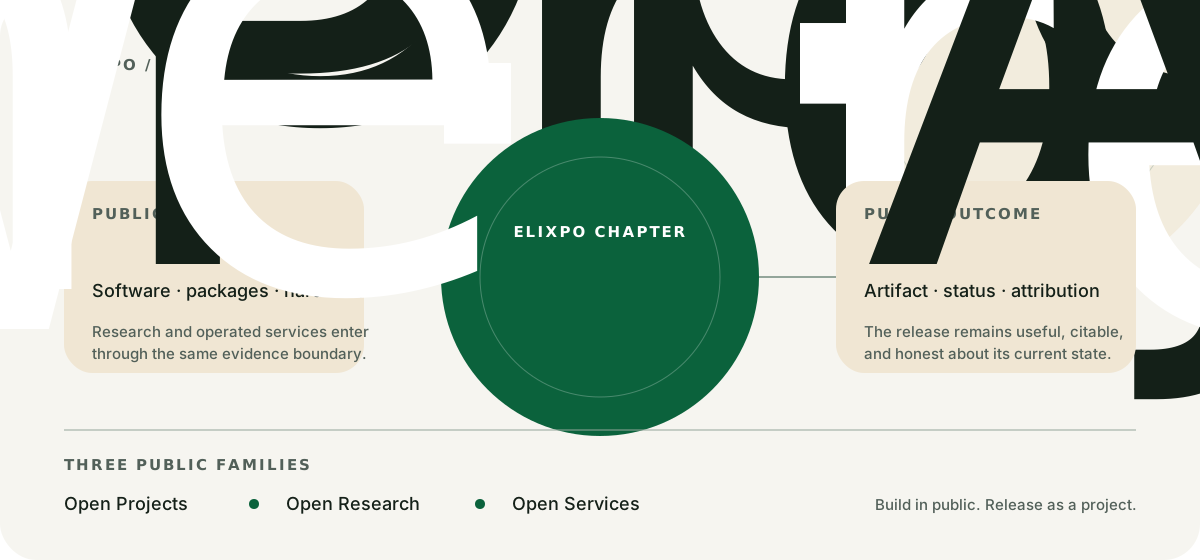
| Public family | Includes |
|---|---|
| Open Projects | Installable software, libraries, developer tools, hardware, packages, and creative projects. |
| Open Research | Papers, experiments, datasets, models, protocols, and reproducible research artifacts. |
| Open Services | Hosted applications and shared infrastructure operated by Elixpo. |
Packages are a distribution surface for Open Projects, not a fourth family. Lifecycle describes the state of the work; Core, Chapter, Member, and Connected describe its relationship to Elixpo.
A Chapter is a time-bounded public build-and-release cycle. It starts with an active maintainer, a credible artifact or prototype, and one meaningful next objective. It ends with a release, prototype, report, package, or an explicit documented closure.
flowchart LR
  A[Selection] --> B[Readiness]
  B --> C[Public build]
  C --> D[Contribution window]
  D --> E[Release or documented closure]
  E --> F[Durable outcome record]
  F -. optional .-> G[Member Project]
Repository transfer is not required. A project may remain with its owner while participating in a Chapter. Member Project status is an ongoing relationship earned through successful collaboration; it does not automatically transfer copyright, trademarks, packages, domains, or project authority.
This directory is generated from the canonical registry. It includes every non-archived public entry and states lifecycle separately from relationship. Feature placement is editorial and does not change these records.
| Repository | Lifecycle | Relationship |
|---|---|---|
cypher |
Incubating | Core |
agent.elixpo |
Active | Core |
elixpo_chapter |
Active | Core |
Kareixo |
Active | Member |
oreo |
Active | Core |
packages.elixpo |
Active | Core |
sketch.elixpo |
Active | Core |
Nano28C64 |
Maintenance | Core |
crumb.elixpo |
Paused | Core |
oreoPI |
Paused | Core |
| Repository | Lifecycle | Relationship |
|---|---|---|
monodiffuse |
Active | Core |
octabit |
Active | Core |
search.elixpo |
Active | Connected |
wozformer |
Active | Core |
qfabric |
Completed | Core |
| Repository | Lifecycle | Relationship |
|---|---|---|
opensource.elixpo |
Incubating | Core |
accounts.elixpo |
Active | Core |
admin.elixpo |
Active | Core |
blogs.elixpo |
Active | Core |
lixrl.com |
Active | Core |
mails.elixpo |
Active | Core |
me.elixpo |
Active | Core |
payouts.elixpo |
Active | Core |
status.elixpo |
Active | Core |
Registry snapshot: 2026-10-17. Archived work remains visible in the GitHub organization as history, not as currently supported work.
The main portal remains the organization directory and canonical source for classification, lifecycle, relationships, and cross-project links. Two specialized repositories operate deeper publication surfaces:
packages.elixpoowns package building, signed APT distribution, release artifacts, installers, and the package catalogue.- Elixpo Research is the standalone publication surface for papers, citations, datasets, models, demonstrations, and reproducibility records. The portal research directory provides the organization-level classification and links each record to its canonical publication. Research code and primary evidence stay in their owning project repositories.
The specialized sites must consume the shared schema or synchronize changes through reviewable pull requests. They do not maintain independent organization directories, silently change lifecycle status, or replace the owning repository as the source of technical evidence.
- Contribute to a project: use the owning repository's contribution guide, current issues, and maintainer review process.
- Follow current conversation: use the moderated Elixpo community index or open the canonical forum on GitHub. The website's latest feed is activity-ordered and is not an editorial endorsement.
- Discuss a Chapter: start with Elixpo Discussions and describe the working artifact, accountable maintainer, next release objective, and availability to review contributions. A discussion is not automatic acceptance or a request to transfer the repository.
- Follow Chapter operations: use the Elixpo Chapter repository.
- Explore installable work: visit Elixpo Packages.
- Follow research: browse the organization research directory, then open the canonical paper, experiment, model, or proposal record on research.elixpo.com.
Credit should point to attributable work—merged changes, reviews, releases, research, design, documentation, or community operations. Repository history is the current evidence source. The People record separates current organization responsibility from project maintenance, alumni, advisors, and community contribution. The contributor records describe attributable public outcomes without presenting a commit total as a measure of human value. The organization timeline states date precision and links the public evidence for every milestone.
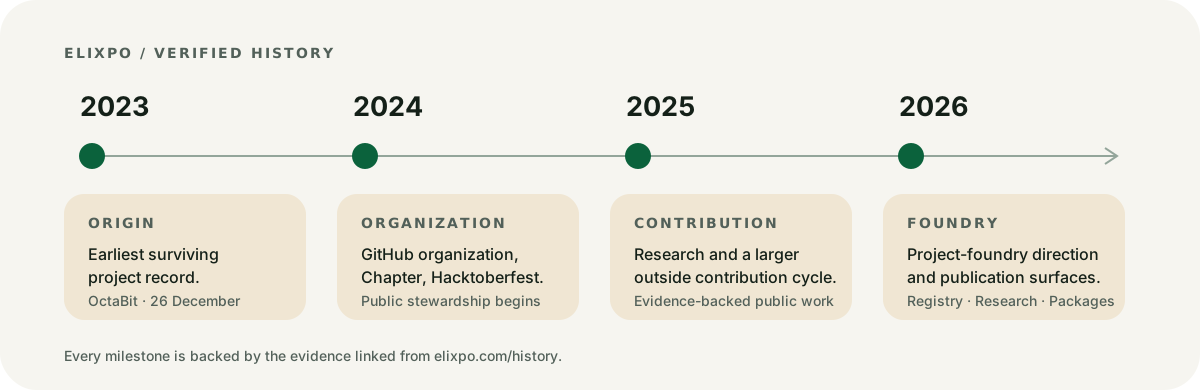
Unknown role dates and empty role categories remain explicit. Elixpo does not infer employment, certification, permanent affiliation, review, or consent for a private biography from a public contribution.
Elixpo does not currently solicit, accept, hold, or route organization-level sponsorship funds. Independently governed projects may publish their own funding routes under their own authority and accounting; listing through Elixpo does not make Elixpo the recipient or intermediary. Funding does not purchase Chapter selection, feature placement, research conclusions, contributor credit, governance authority, or favourable editorial treatment.
Licenses vary by project and artifact. The terms in the owning repository or artifact record control, and existing work is not silently relicensed when it joins Elixpo. New Elixpo-owned code defaults to MIT, with Apache-2.0 available where its patent grant is useful; papers and general documentation default to CC BY 4.0; new hardware source defaults to CERN-OHL-S-2.0. Datasets, models, weights, and brand assets require artifact-specific review.
Copyright permission does not grant permission to impersonate Elixpo or claim endorsement. The canonical brand destination is the Elixpo asset library. Colour tokens, typography guidance, and general usage guidance are public. Official sticker artwork is shown only as a watermarked preview; print-ready files or physical packs are released through an approved written event partnership. Accurate referential use and protected uses are defined by the published trademark and brand-use policy.
Website · GitHub · Discussions · Chapter · Research · Packages · People · History