


Hack The Box's fork of hipages/php-fpm_exporter, originally created by Enrico Stahn and hipages, and used here under the Apache-2.0 licence. Thank you for the original project.
We maintain this for Hack The Box's needs. Use at your own risk. Pull requests are welcome; no support is promised. If you need a supported product, this is not one.
Upstream's last release was v2.2.0 in May 2022. This fork carries fixes for crashes and incorrect metrics that upstream still has open. See Differences from upstream.
Images are published to GHCR only, not Docker Hub:
ghcr.io/hackthebox/php-fpm_exporter.
A prometheus exporter for PHP-FPM. The exporter connects directly to PHP-FPM and exports the metrics via HTTP.
A webserver such as NGINX or Apache is NOT needed!
- Differences from upstream
- Features
- Usage
- Metrics collected
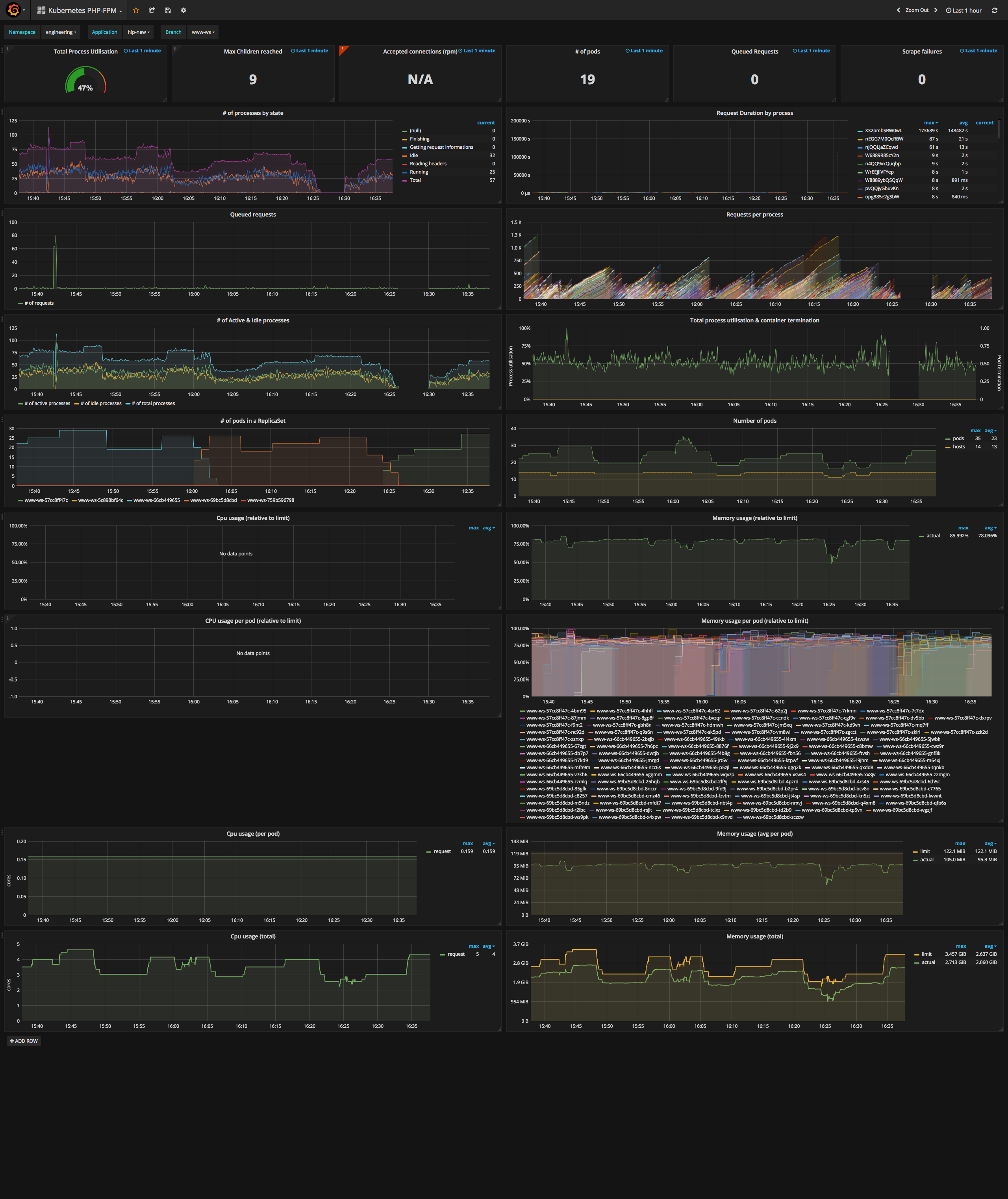
- Grafana Dasbhoard for Kubernetes
- FAQ
- Development
- Contributing
- Contributors
- Alternatives
Upstream's last release was v2.2.0 in May 2022. Everything below is fixed here and, at the time of writing, not upstream.
Crashes and hangs
- A malformed
--phpfpm.scrape-urino longer panics the process.url.Parsereturns a nil URL alongside its error and the result was dereferenced anyway, inside the scrape goroutine, so a single typo took the exporter down. Present upstream since 2018. /metricsno longer hangs and leaks a goroutine and socket per scrape when a PHP-FPM/statusstalls, for example during a graceful reload. Every request now runs under a connection deadline (upstream #253, open since 2022).- Removing a pool no longer races its own loop. Under Kubernetes pod deletion this could index past the end of the slice and panic.
Metrics correctness
- Every process stage PHP-FPM reports is counted.
Finishing,EndingandGetting request informationsat in emptyswitchcases and vanished from the totals, sophpfpm_total_processesdrifted below the real process count under load (upstream #322, open since 2023). - The
Creatingstage is recognised, instead of loggingUnknown process state 'Creating'on every scrape (upstream #419). - A failed scrape is logged once per pool, not three times.
CLI behaviour
get --out jsonemits valid JSON.request durationwas rendered as a pointer address, so the whole document failed to parse.getexits non-zero when a target cannot be scraped, and rejects an unknown--outvalue.- An invalid
--log.levelfalls back toinfowith a warning instead of killing the process.
Additions
- Kubernetes pod auto-tracking (
--k8s.autotracking): discovers PHP-FPM pods by label and adds or removes them as they come and go, adding aphpfpm_podlabel. See Kubernetes Example.
- Export single or multiple pools
- Export to CLI as text or JSON
- Connects directly to PHP-FPM via TCP or Socket
- Maps environment variables to CLI options
- Fix for PHP-FPM metrics oddities
- Grafana Dashboard for Kubernetes
php-fpm_exporter is released as a binary and a container image on GHCR.
It uses sensible defaults which usually avoids the need to use command parameters or environment variables.
php-fpm_exporter supports 2 commands, get and server.
The get command allows to retrieve information from PHP-FPM without running as a server and exposing an endpoint.
It prints whatever it managed to collect and exits non-zero if any target could not be scraped, so it can be used in scripts and health checks.
The server command runs the server required for prometheus to retrieve the statistics.
| Option | Description | Environment variable | Default value |
|---|---|---|---|
--web.listen-address |
Address on which to expose metrics and web interface. | PHP_FPM_WEB_LISTEN_ADDRESS |
:9253 |
--web.telemetry-path |
Path under which to expose metrics. | PHP_FPM_WEB_TELEMETRY_PATH |
/metrics |
--phpfpm.scrape-uri |
FastCGI address, e.g. unix:///tmp/php.sock;/status or tcp://127.0.0.1:9000/status | PHP_FPM_SCRAPE_URI |
tcp://127.0.0.1:9000/status |
--phpfpm.fix-process-count |
Enable to calculate process numbers via php-fpm_exporter since PHP-FPM sporadically reports wrong active/idle/total process numbers. | PHP_FPM_FIX_PROCESS_COUNT |
false |
--log.level |
Only log messages with the given severity or above. Valid levels: [debug, info, warn, error, fatal] (default "error") | PHP_FPM_LOG_LEVEL |
info |
php-fpm_exporter implements an option to "fix" the reported metrics based on the provided processes list by PHP-FPM.
We have seen PHP-FPM provide metrics (e.g. active processes) which don't match reality.
Specially active processes being larger than max_children and the actual number of running processes on the host.
Looking briefly at the source code of PHP-FPM it appears a scoreboard is being kept and the values are increased/decreased once an action is executed.
The metric active processes is also an accumulation of multiple states (e.g. Reading headers, Getting request information, Running).
Which shouldn't matter and active processes should still be equal or lower to max_children.
--phpfpm.fix-process-count will emulate PHP-FPMs implementation including the accumulation of multiple states.
PHP-FPM treats a child as idle only while it is accepting; every other stage (Creating, Reading headers,
Getting request information, Running, Finishing, Ending) counts as active. total processes is therefore
always the number of processes PHP-FPM reported.
If you like to have a more granular reporting please use phpfpm_process_state.
- https://bugs.php.net/bug.php?id=76003
- https://stackoverflow.com/questions/48961556/can-active-processes-be-larger-than-max-children-for-php-fpm
-
Retrieve information from PHP-FPM running on
127.0.0.1:9000with status endpoint being/statusphp-fpm_exporter get -
Retrieve information from PHP-FPM running on
127.0.0.1:9000and127.0.0.1:9001php-fpm_exporter get --phpfpm.scrape-uri tcp://127.0.0.1:9000/status,tcp://127.0.0.1:9001/status -
Run as server with 2 pools:
php-fpm_exporter server --phpfpm.scrape-uri tcp://127.0.0.1:9000/status,tcp://127.0.0.1:9001/status -
Run as server and enable process count fix via environment variable:
PHP_FPM_FIX_PROCESS_COUNT=1 go run main.go server --web.listen-address ":12345" --log.level=debug
-
Run docker manually
docker pull ghcr.io/hackthebox/php-fpm_exporter docker run -it --rm -e PHP_FPM_SCRAPE_URI="tcp://127.0.0.1:9000/status,tcp://127.0.0.1:9001/status" ghcr.io/hackthebox/php-fpm_exporter -
Run the docker-compose example
git clone git@github.com:hackthebox/php-fpm_exporter.git
cd php-fpm_exporter/test
docker-compose -p php-fpm_exporter up
You can now access the following links:
- Prometheus: http://127.0.0.1:9090/
- php-fpm_exporter metrics: http://127.0.0.1:9253/metrics

Run the exporter with Kubernetes discovery enabled:
php-fpm_exporter server --k8s.autotracking --k8s.namespace my-namespace --k8s.pod-labels 'php-fpm-exporter/collect=true'When Kubernetes auto-tracking is enabled, every emitted metric includes a phpfpm_pod label populated with the discovered PHP-FPM pod name. Static --phpfpm.scrape-uri targets have no pod name, so they do not carry the label at all.
# HELP phpfpm_accepted_connections The number of requests accepted by the pool.
# TYPE phpfpm_accepted_connections counter
# HELP phpfpm_active_processes The number of active processes.
# TYPE phpfpm_active_processes gauge
# HELP phpfpm_idle_processes The number of idle processes.
# TYPE phpfpm_idle_processes gauge
# HELP phpfpm_listen_queue The number of requests in the queue of pending connections.
# TYPE phpfpm_listen_queue gauge
# HELP phpfpm_listen_queue_length The size of the socket queue of pending connections.
# TYPE phpfpm_listen_queue_length gauge
# HELP phpfpm_max_active_processes The maximum number of active processes since FPM has started.
# TYPE phpfpm_max_active_processes counter
# HELP phpfpm_max_children_reached The number of times, the process limit has been reached, when pm tries to start more children (works only for pm 'dynamic' and 'ondemand').
# TYPE phpfpm_max_children_reached counter
# HELP phpfpm_max_listen_queue The maximum number of requests in the queue of pending connections since FPM has started.
# TYPE phpfpm_max_listen_queue counter
# HELP phpfpm_process_last_request_cpu The %cpu the last request consumed.
# TYPE phpfpm_process_last_request_cpu gauge
# HELP phpfpm_process_last_request_memory The max amount of memory the last request consumed.
# TYPE phpfpm_process_last_request_memory gauge
# HELP phpfpm_process_request_duration The duration in microseconds of the requests.
# TYPE phpfpm_process_request_duration gauge
# HELP phpfpm_process_requests The number of requests the process has served.
# TYPE phpfpm_process_requests counter
# HELP phpfpm_process_state The state of the process (Idle, Running, ...).
# TYPE phpfpm_process_state gauge
# HELP phpfpm_scrape_failures The number of failures scraping from PHP-FPM.
# TYPE phpfpm_scrape_failures counter
# HELP phpfpm_slow_requests The number of requests that exceeded your 'request_slowlog_timeout' value.
# TYPE phpfpm_slow_requests counter
# HELP phpfpm_start_since The number of seconds since FPM has started.
# TYPE phpfpm_start_since counter
# HELP phpfpm_total_processes The number of idle + active processes.
# TYPE phpfpm_total_processes gauge
# HELP phpfpm_up Could PHP-FPM be reached?
# TYPE phpfpm_up gauge
The Grafana dashboard can be found here. There is also a more generic version here.
-
How to update "Metrics collected"?
Copy&paste the output from:
curl http://127.0.0.1:12345/metrics | grep phpfpm | grep "#"
The E2E tests are based on docker-compose and bats-core. Install the required components, e.g. via brew on MacOS:
brew tap kaos/shell
brew install docker-compose bats-core kaos/shell/bats-assert kaos/shell/bats-support
After the components are installed run the E2E tests:
make test-e2eContributions are greatly appreciated. The maintainers actively manage the issues list, and try to highlight issues suitable for newcomers. The project follows the typical GitHub pull request model. See " How to Contribute to Open Source " for more details. Before starting any work, please either comment on an existing issue, or file a new one.
Thanks goes to these wonderful people (emoji key).
Most of this exporter was written before Hack The Box ever forked it. The people below built it, and the fork stands on their work.


This project follows the all-contributors specification. Contributions of any kind welcome!