


(example with sm64ex-fpv)
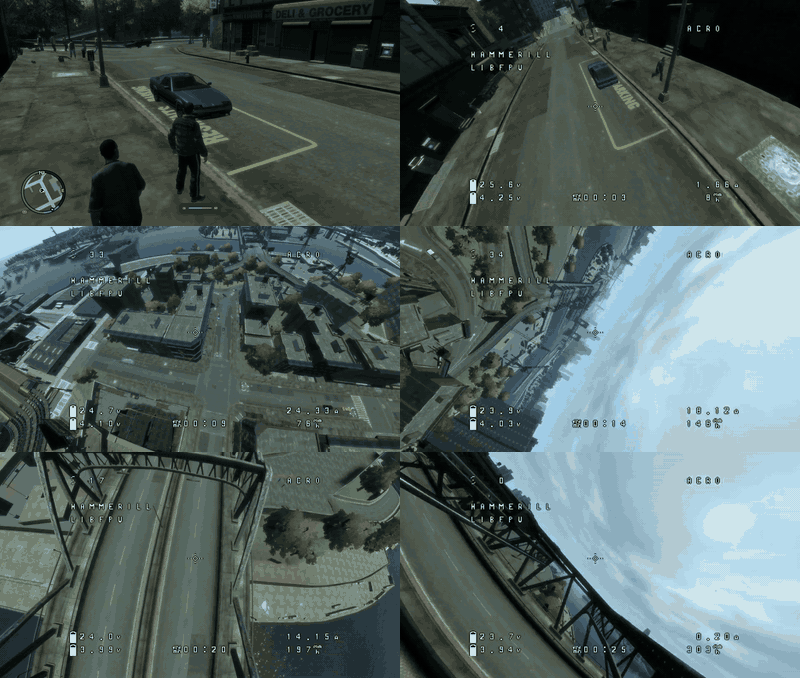
(another one with gtaiv-fpv)
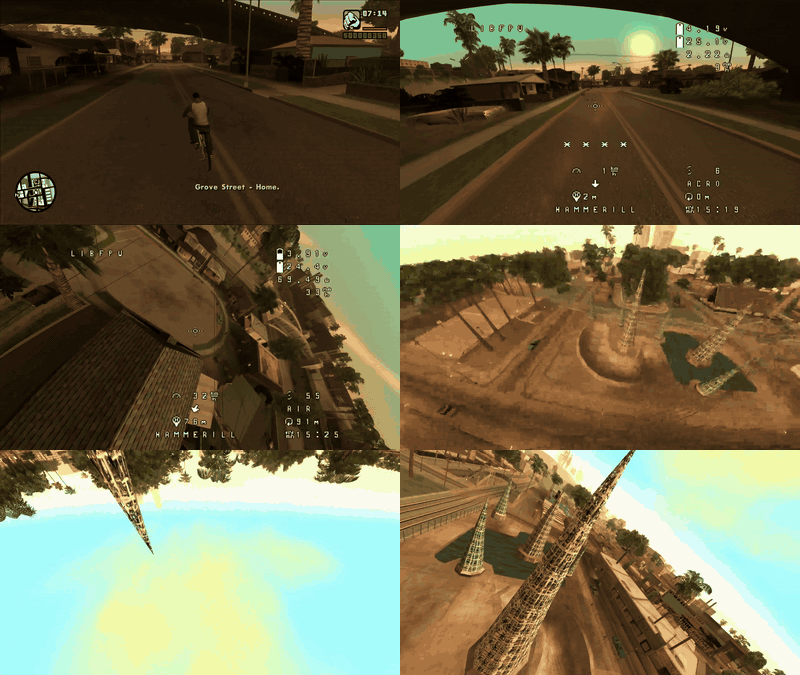
(yet another with gtasa-fpv)
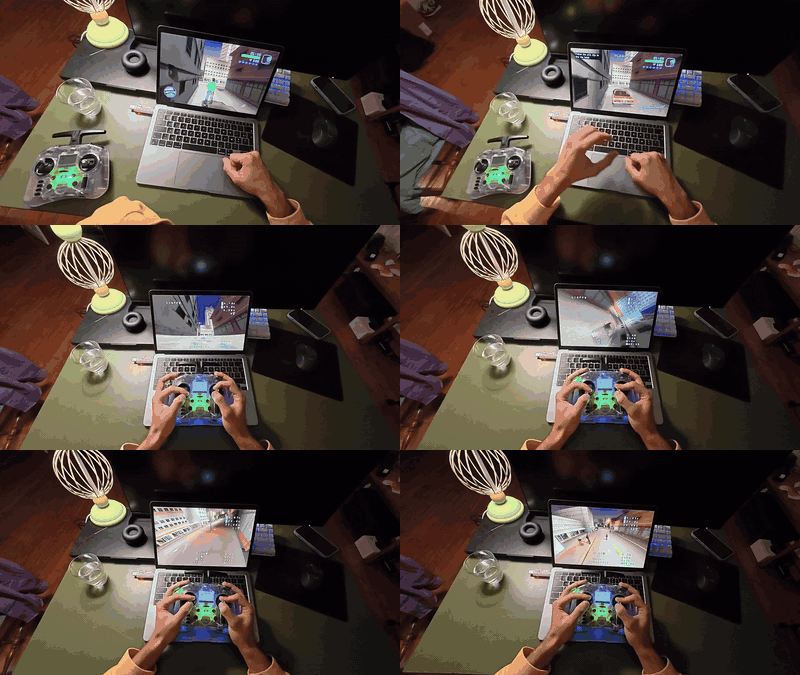
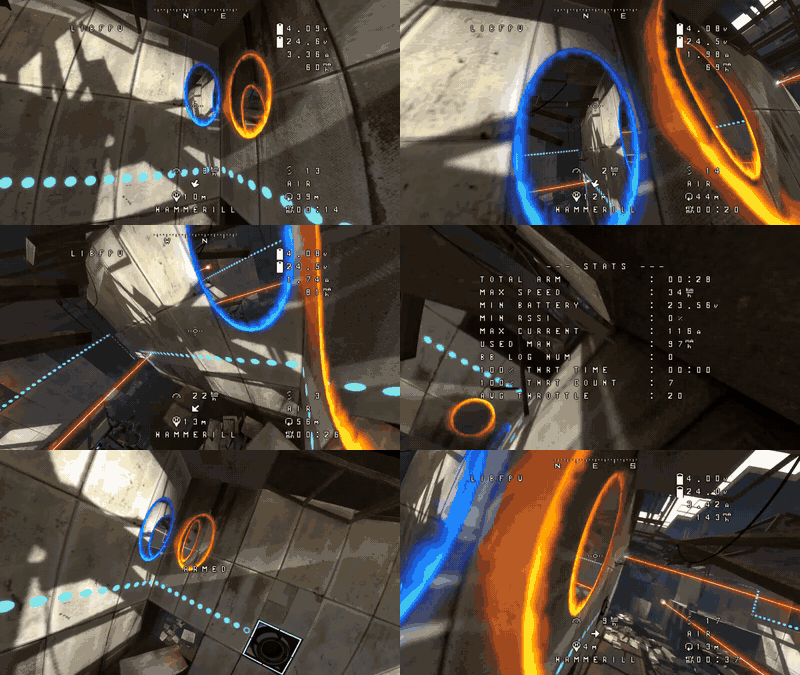
A drop-in FPV quadcopter for any game. libfpv runs real Betaflight firmware (through SimITL) on its own 1 kHz simulation thread, reads the player's radio or gamepad, and gives the game everything it needs to draw one rendered frame: the drone's pose, the FPV, chase and line-of-sight cameras, motor RPMs, impacts, a Betaflight OSD, a settings overlay and motor sound.
The game supplies collision geometry and draws the result. libfpv has no renderer of its own, and its API is plain C, so it can be loaded from any engine or mod loader.
- Betaflight in the loop. The firmware is real Betaflight 2025.12, so
rates, modes, filters and arming behave as they do on a real quad. Betaflight
Configurator can connect over WebSocket (
ws://localhost:5761). The Betaflight CLI is available in-process, anddiff allfrom a real quad can be imported. - Physics presets. Frame, motor, propeller, battery, VTX and camera are
set in JSON presets (
assets/presets/), with a separate EEPROM for each quad. Players can turn off the battery drain and the prop and motor damage. - GPS. A simulated GPS and barometer drive Betaflight's speed, home
arrow and distance, altitude, vario and distance-flown elements. The game
can set where home is with
fpv_gps_set_home. - Collisions. The game provides static meshes, moving objects or a raycast callback, and libfpv reports impacts and prop damage.
- Wind. The game gives its weather's wind, and the drone flies in it: stronger higher up, gusty, calm in the lee of buildings and indoors, with helicopter downwash and blast waves. Betaflight has to hold the quad against it. Players can turn it off.
- Input. Radios and gamepads are read through an embedded, hidden SDL3, with a radio setup wizard (arm, angle, beeper, turtle, air mode and OSD disable switches). Keyboard and gamepad fallbacks are included. The game's own actions (fire, grab, open) can go on radio switches and buttons too, next to the flight modes.
- Portals, pushes and cargo. Linked portals the drone flies through with its momentum, launch pads and bounces, and things carried under the drone with their weight.
- Presentation. The OSD uses Betaflight's MAX7456 fonts (analog or HD
look). A Dear ImGui overlay opens on F8, and synthesized motor and beeper
sound comes through
fpv_audio_read, heard onboard or from the pilot: quieter far away and behind walls, with Doppler, the ground's reflection and echoes. Both the OSD and the overlay are returned as textured triangles, so one small renderer draws both. - Camera. Uptilt and FOV are adjustable, and there is a fisheye lens (on by default). Analog video noise grows with range and with obstacles in the way.
- Web builds. A game with source code available can ship its mod as a web page. The game and libfpv compile to WebAssembly, and players fly from a link with nothing to install. Radio, keys, overlay, OSD, sound and saved settings all work in the browser (docs/WEB.md).
Requirements: CMake 3.24 or newer, a C11/C++17 compiler (GCC or Clang), and the usual X11/Wayland and audio development headers for SDL3 on Linux. On macOS the Xcode command line tools are enough.
git clone --recursive https://github.com/hammerill/libfpv.git
cd libfpv
cmake -S . -B build/linux
cmake --build build/linux -j
ctest --test-dir build/linux
If you cloned without --recursive, run git submodule update --init
first. The SimITL and Betaflight patches in patches/ are applied
automatically at configure time.
The default build type is Release. Outputs in the build directory:
| File | What it is |
|---|---|
libfpv.so (libfpv.dylib on macOS, libfpv.dll + libfpv.def on Windows) |
the library |
examples/fpv_standalone |
a small SDL3 + OpenGL 3.3 game that uses every libfpv hook |
examples/fpv_minimal |
the smallest headless integration |
tests/fpv_tests |
the test suite |
| Option | Default | |
|---|---|---|
LIBFPV_WITH_SDL |
ON |
Read radios and gamepads with the embedded SDL3 |
LIBFPV_WITH_OVERLAY |
ON |
Build the Dear ImGui overlay |
LIBFPV_BUILD_TESTS |
ON |
Build the test suite |
LIBFPV_BUILD_EXAMPLES |
ON |
Build the examples |
Windows builds are cross-compiled from Linux with MinGW-w64 (install the
-posix variant). All runtimes are linked statically, so libfpv.dll
depends only on Windows system DLLs:
cmake -S . -B build/win -DCMAKE_TOOLCHAIN_FILE=cmake/toolchains/mingw-w64-x86_64.cmake
cmake --build build/win -j
For 32-bit games (such as GTA IV), use cmake/toolchains/mingw-w64-i686.cmake
with -B build/win32 instead.
MSVC hosts can make an import library with lib /def:libfpv.def /machine:x64
or load the DLL with LoadLibrary.
Browser builds use Emscripten (4.0 or newer):
source /path/to/emsdk/emsdk_env.sh
emcmake cmake -S . -B build/web
cmake --build build/web -j
node build/web/tests/fpv_tests.js
This makes libfpv.a for the game's WebAssembly module, and
build/web/web/, the standalone example as a page (index.html,
index.js, index.wasm) that any static web host can serve. See
docs/WEB.md for porting a mod and for what differs in a
browser.
tools/run-tests.sh builds and runs the test suite with no network access.
It runs natively by default; with --web it does the same Emscripten + Node
run as CI. It can run only some tests, and with --repeat it reruns them to
catch flaky ones:
tools/run-tests.sh                          # native, every test
tools/run-tests.sh --web                    # as in CI (needs an installed emsdk)
tools/run-tests.sh --repeat 20 sim_options # one test, 20 timesgit pull alone is usually not enough. It does not move the submodules to
their new commits, and cmake --build does not apply patches that were added
to patches/; only a configure does. After each pull, run:
git pull
git submodule update --init
cmake -S . -B build/linux    # once for each build directory you use
cmake --build build/linux -j
The patched submodules are marked ignore = dirty, so git status will not
tell you they are out of date. If the build fails with undeclared Betaflight
or SimITL symbols after a pull, a patch is probably missing. Reset the
submodules (this discards any local changes in them) and configure again:
git submodule foreach 'git checkout -- . && git clean -fd'
git submodule update --init
cmake -S . -B build/linux
macOS builds natively with Apple Clang (tested on Apple Silicon):
cmake -S . -B build/mac
cmake --build build/mac -j
ctest --test-dir build/mac
Hidden symbols keep the embedded SDL3's C functions private, but
Objective-C classes share one global namespace. If the game also links
SDL3, the Objective-C runtime warns that classes such as SDL3Window are
implemented twice, and which copy is used is undefined. fpv_standalone
shows these warnings because it links its own SDL3 on purpose. To avoid the
duplicate classes, build with -DLIBFPV_WITH_SDL=OFF and pass input in
with fpv_input_set_channels.
cmake -S . -B build/asan -DCMAKE_BUILD_TYPE=Debug \
  -DCMAKE_C_FLAGS="-fsanitize=address -fno-omit-frame-pointer" \
-DCMAKE_CXX_FLAGS="-fsanitize=address -fno-omit-frame-pointer"./build/linux/examples/fpv_standalone| Key | Action |
|---|---|
| F8 | libfpv overlay (preset, radio setup, rates, camera, Betaflight CLI); Esc closes it |
| V | Camera: FPV / chase / line of sight |
| R | Repair and respawn |
| F11 or Alt+Enter | Fullscreen |
| Esc | Quit |
Without a radio, use the keyboard: Enter arms, W/S move the throttle, A/D
is yaw (starting slow and rising exponentially to full while held, how fast
is set in F8 > Controls) and the arrow keys pitch and roll (self-level).
With "Automatic hover throttle" on (F8 > Controls; by default it is on
while no radio is connected), W climbs (the
throttle rises exponentially to full; its speed is set there too), S cuts
the throttle, and no key (or both) hovers at a throttle learned in flight
for each drone. T toggles turtle mode: to
flip a crashed drone back over, turn it on, arm, hold an arrow key until
it lands upright, then turn turtle off to fly away.
Settings, EEPROMs and the
selected preset are stored in ./data (change it with
--data <dir>).
The web build of the same example runs in a browser:
python3 -m http.server -d build/web/web 8080 # then open http://localhost:8080fpv_global_config cfg;
fpv_global_config_defaults(&cfg);
cfg.data_dir = "<writable folder>";
cfg.coords = fpv_coords_preset(FPV_COORDS_Y_UP_RIGHT_HANDED, 1.0f);
fpv_global_init(&cfg); // once
fpv_static_surfaces_load(&level_mesh, 1); // world collision
fpv_drone *d;
fpv_drone_create(NULL, &d); // spawn
// every frame
fpv_drone_tick(d, dt, &frame);
// place the game camera at frame.camera, draw the drone at frame.position /
// frame.rotation, then draw fpv_osd_draw_data() and fpv_overlay_render()
fpv_global_terminate(); // on unload / exitinclude/libfpv.h: the whole API, documented inline (threading, memory ownership, ABI rules).docs/INTEGRATION.md: integration details, such as the fisheye post-process shader, and lessons from real integrations (GTA IV).docs/renderers/fpv_render_gl3.h: a single-header OpenGL 3.3 / ES 3.0 renderer for the OSD and the overlay.examples/standalone/main.cpp: a complete integration, with a comment at the top listing every hook in order.docs/WEB.md: compiling a game and its mod into a web page.docs/PUBLISHING.md: releasing a finished mod so players only download one ZIP or open one link (automatic builds, the install page, licensing).docs/DECISIONS.md: why things are the way they are.
include/      public C API (libfpv.h)
src/          library: sim/, config/, input/, world/, osd/, overlay/, audio/, web/
assets/       presets and OSD fonts (embedded into the library at build time)
patches/      patch series applied to the SimITL and Betaflight submodules
third_party/  SimITL, Betaflight, libwebsockets, fmt, SDL, Dear ImGui, nlohmann/json
examples/     fpv_minimal and fpv_standalone
tests/        test suite and real-quad `diff all` fixtures
cmake/        core build, file embedding, toolchains, symbol export lists
tools/        patch series helper, WebAssembly symbol localizer
GPL-3.0-or-later. libfpv embeds Betaflight, so any mod or program that links it must be distributed under GPL-3.0-compatible terms. See LICENSE for the full text.