


Flash-ANSR is a library for amortized neural symbolic regression: load a pretrained model, call fit(X, y), and recover a symbolic expression for your tabular data, or train your own model. It is built for fast, ready-to-use inference.
- Saegert & Köthe 2026, Breaking the Simplification Bottleneck in Amortized Neural Symbolic Regression (ICML 2026) https://arxiv.org/abs/2602.08885
Requires Python >= 3.12.
pip install flash-ansr
flash_ansr install psaegert/flash-ansr-v25.0-T8-20M   # the reference checkpoint (see "Models")
import numpy as np
import torch
from flash_ansr import FlashANSR, SoftmaxSamplingConfig, get_path
device = "cuda" if torch.cuda.is_available() else "cpu"
# The estimator's policy is fixed at construction: the sampler, the refiner, the ranking, the compute.
model = FlashANSR.load(
directory=get_path("models", "psaegert/flash-ansr-v25.0-T8-20M"),
generation_config=SoftmaxSamplingConfig(draws=1024), # the search budget: expressions drawn per problem
ranking="mdl", # the two-part code: (n/2) log2 FVU + description length in bits (default)
compute={"device": device},
)
# Define data: a small synthetic example, y = 2 * x + sin(3 * x)
X = np.linspace(-5, 5, 100).reshape(-1, 1)
y = 2 * X[:, 0] + np.sin(3 * X[:, 0])
# One call: draw candidates, fit their constants, rank them
result = model.fit(X, y)
print(result.best.expression_infix) # the answer
print(model.get_expression()) # the same, read back from the estimator
y_pred = model.predict(X) # evaluate the answer on new dataThe result. fit returns a FitResult and keeps it as model.result_: the score-sorted refined candidates (each a Candidate with its expression, constants, fvu, score, mdl, log_prob, ...), the full ledger (every draw, classified FIT_OK / FIT_FAILED / INVALID), the ranking that ordered them and the generation / refinement times. Everything else is a view of it:
result.predict(X, rank=3)                                   # evaluate the candidate at rank 3
result.get_expression(rank=3, precision=3)                  # render it, constants rounded for display
result.to_dataframe()                                       # one row per refined candidate
result.rerank("weighted", weights={"n_nodes": 0.05})        # a NEW result under another ranking, no refit
result.save("result.pkl")                                   # plain data: no model objects inside
FitResult.load("result.pkl", engine=model.simplipy_engine)  # ... and back, evaluable again
The call. Everything that changes with the problem is an argument of fit: draws= overrides the budget for this call, seed= makes the draw and the refinement reproducible, complexity= hints the target complexity, on_empty="raise" raises ConvergenceError instead of returning an empty result when nothing fitted, variable_names= names the columns. Everything else is policy and lives on the estimator.
Flash-ANSR + PySR. flash_ansr.hybrid.HybridRegressor lets Flash-ANSR's best candidates seed PySR's evolutionary search, prices PySR's hall of fame the way Flash-ANSR prices its own candidates, and lets Flash-ANSR's ranking pick from the combined pool (pip install flash-ansr[pysr]; see the guide):
from flash_ansr.hybrid import HybridRegressor

hybrid = HybridRegressor(model)     # by default 1024 draws, then 64 PySR iterations: both stages take the same time
result = hybrid.fit(X, y)           # a FitResult of the combined pool; result.best.source says where the answer came from
Explore more in the Demo Notebook.
Train your own: see the training guide.
The v25.0-T8 series: one recipe and one data prior at three sizes. Pick by the hardware you have; every one of them runs the examples above unchanged.
| Checkpoint | Parameters | Training | Notes |
|---|---|---|---|
psaegert/flash-ansr-v25.0-T8-3M |
3.5M | 1.5M steps, batch 128, configs/v25.0-T8-3M |
the smallest; comfortable on a CPU |
psaegert/flash-ansr-v25.0-T8-20M |
23.7M | 1.5M steps, batch 128, configs/v25.0-T8-20M |
the reference checkpoint for this release |
psaegert/flash-ansr-v25.0-T8-120M |
123.6M | 1.5M steps, batch 128, configs/v25.0-T8-120M |
the largest; a GPU is advisable |
flash_ansr install psaegert/flash-ansr-v25.0-T8-20MEvery catalog that srbf evaluates on is held out of the training data by canonical form (6,660 expressions across 29 catalogs).
Several inference-speed features are enabled by default and designed to be quality-neutral, so the quickstart above already runs in the fast regime. The speed-relevant settings are the compute group of the generation config:
| Setting | Default | What it does |
|---|---|---|
use_cache |
True |
KV-cache decoding |
batch_size |
'auto' |
budget-adaptive batching (pass an int to override) |
static_decode |
None |
static decoding, auto-enabled for capable models (set True/False to force) |
from flash_ansr import SoftmaxSamplingConfig

config = SoftmaxSamplingConfig(
  draws=1024,          # number of candidate expressions to draw per problem (fit(draws=) overrides it)
  use_cache=True,      # KV cache (default)
  batch_size='auto',   # budget-adaptive chunking (default)
  static_decode=None,  # auto for capable models (default)
)
Constant refinement runs in parallel; control it via compute={"workers": N, "persistent_pool": True} on FlashANSR.load. By default (workers=None) the pool uses every available CPU core, which oversubscribes shared machines; pass an explicit integer to cap it (0 disables multiprocessing).
To opt out of these defaults:
SoftmaxSamplingConfig(draws=1024, use_cache=False, batch_size=128, static_decode=False)Candidate ranking. Three modes, one sort:
ranking="mdl"(default; the two-part code(n/2) * log2(FVU) + bits: the data coded under the candidate's residual variance plus the refined expression's description length,nthe support size, so more data buys more complexity;{"mode": "mdl", "mdl_strength": 1e-2}fixes the per-bit weight instead),{"mode": "weighted", "weights": {...}}(weights overn_nodes,n_constants,n_constant_placeholders,n_typed_literals,mdl,neg_log_prob) and{"mode": "pareto", "metrics": [...], "tie_break": ...}(the non-dominated front over the metrics). Each knob belongs to one mode and raises under another. A fitted result can be re-ordered under any ranking without refitting:result.rerank(...).

Results on the SRSD/FastSRB benchmark [Matsubara et al. 2022], [Martinek 2025] Left: Validation Numeric Recovery Rate (vNRR) as a function of inference time (log scale). FLASH-ANSR models (shades of blue) scale monotonically with compute, with the 120M model partially surpassing the PySR baseline (red). Baselines NeSymReS [Biggio et al. 2021] and E2E [Kamienny et al. 2022] fail to generalize to the benchmark. Right: Expression Length Ratio (predicted vs ground truth) versus compute. We observe a parsimony inversion: while PySR [Cranmer 2023] increases complexity to minimize error over time, FLASH-ANSR converges toward simpler, more canonical expressions as the sampling budget increases. Shaded regions denote 95% confidence intervals. |
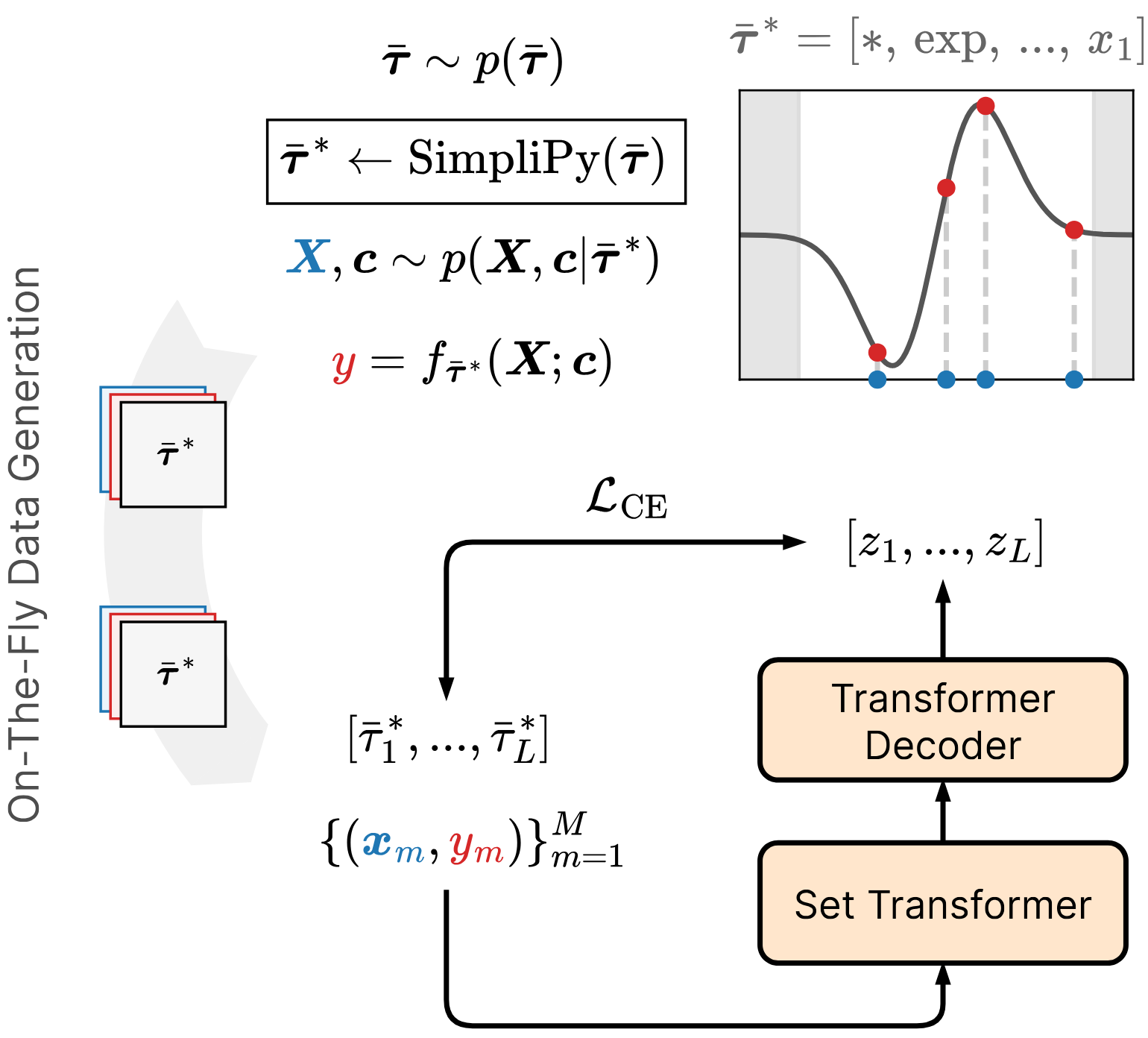
The Flash-ANSR training pipeline. Following the established standard encoder-decoder paradigm, our framework integrates SimpliPy (top center) into the loop for synchronous simplification of on-the-fly generated training expressions. |

Flash-ANSR model architecture. The Set Transformer [Lee et al. 2019] encoder ingests a variable-sized set of input-output pairs and produces a fixed-size latent representation via Induced Set Attention Blocks (ISAB) and Set Attention Blocks (SAB). The Transformer decoder [Vaswani et al. 2017], [Xiong et al. 2020] autoregressively generates a symbolic expression token-by-token, attending to the encoded dataset at each step. |
- SimpliPy: the expression simplification engine integrated into the Flash-ANSR training loop.
- symbolic-data: the model-agnostic symbolic-regression data layer (catalogs,
ProblemSource, holdouts) that feeds Flash-ANSR training. It is an unconditional runtime dependency and the backbone of the training loop. - srbf: the companion symbolic-regression evaluation and benchmarking framework (engine, model adapters, benchmarks, metrics), developed alongside Flash-ANSR.
@inproceedings{saegert2026breakingsimplificationbottleneckamortized,
  title   = {Breaking the Simplification Bottleneck in Amortized Neural Symbolic Regression},
  author  = {Paul Saegert and Ullrich Köthe},
  booktitle = {Proceedings of the 43rd International Conference on Machine Learning (ICML)},
  year    = {2026},
  eprint  = {2602.08885},
  archivePrefix =  {arXiv},
  primaryClass  = {cs.LG},
  url     = {https://arxiv.org/abs/2602.08885},
}

% Optionally
@mastersthesis{flash-ansr2024-thesis,
  author  = {Paul Saegert},
  title   = {Flash Amortized Neural Symbolic Regression},
  school  = {Heidelberg University},
  year    = {2025},
  url     = {https://github.com/psaegert/flash-ansr-thesis}
}
@software{flash-ansr2024,
  author  = {Paul Saegert},
  title   = {Flash Amortized Neural Symbolic Regression},
  year    = {2024},
  publisher   = {GitHub},
  version = {0.14.0},
  url     = {https://github.com/psaegert/flash-ansr}
}