

From agent trajectory datasets and traces to the tools you already use.


What You Can Do · Quick Start · Datasets · Add a Dataset · Capture · Reference
# pip install "agentpile[hf,view]"
import agentpile as ap

run = next(ap.load("who_and_when"))   # one of 14 datasets by name, or a trace file by path
ap.show(run)                          # every step, call and result, with the source's labels beside them
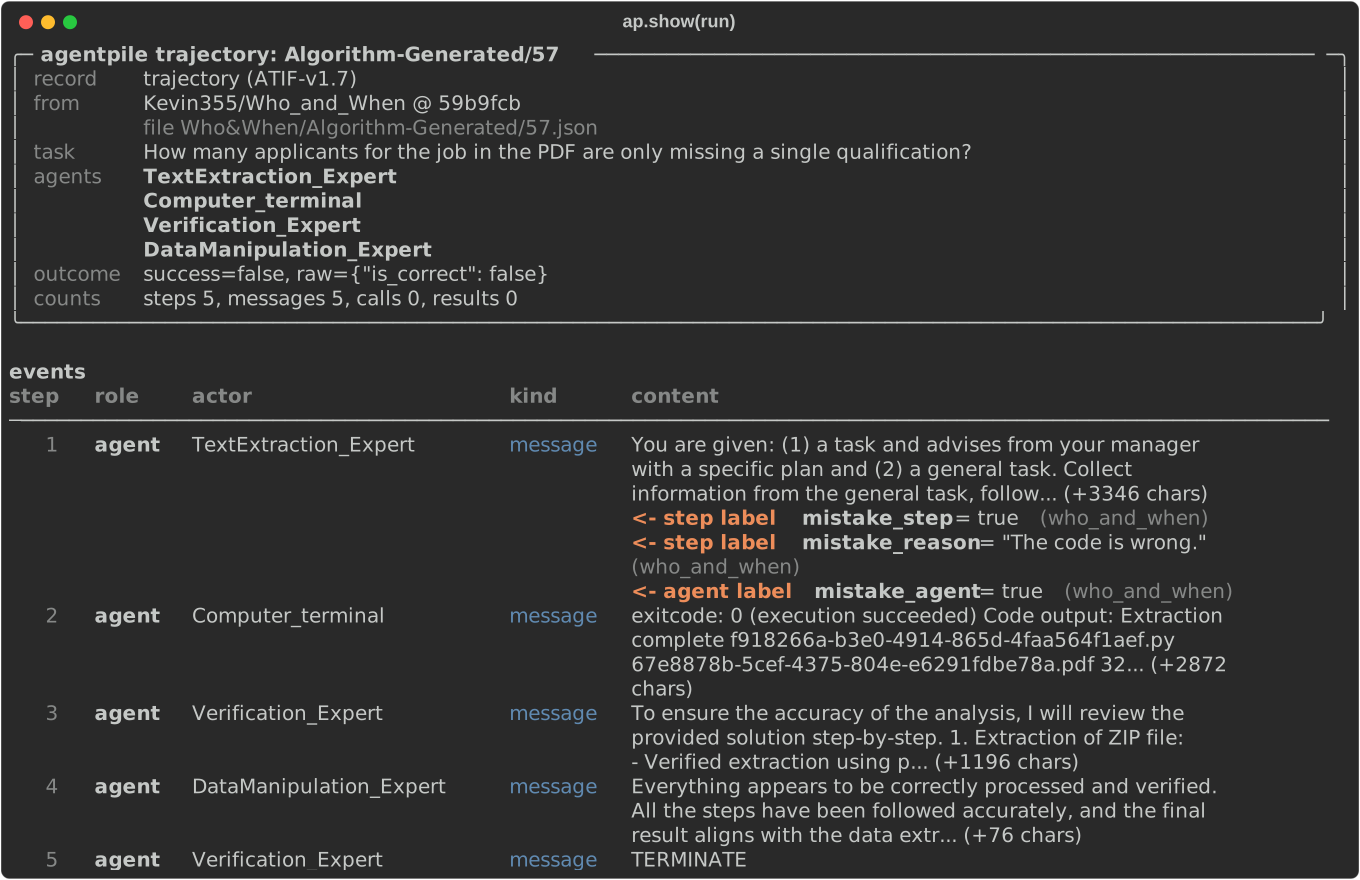
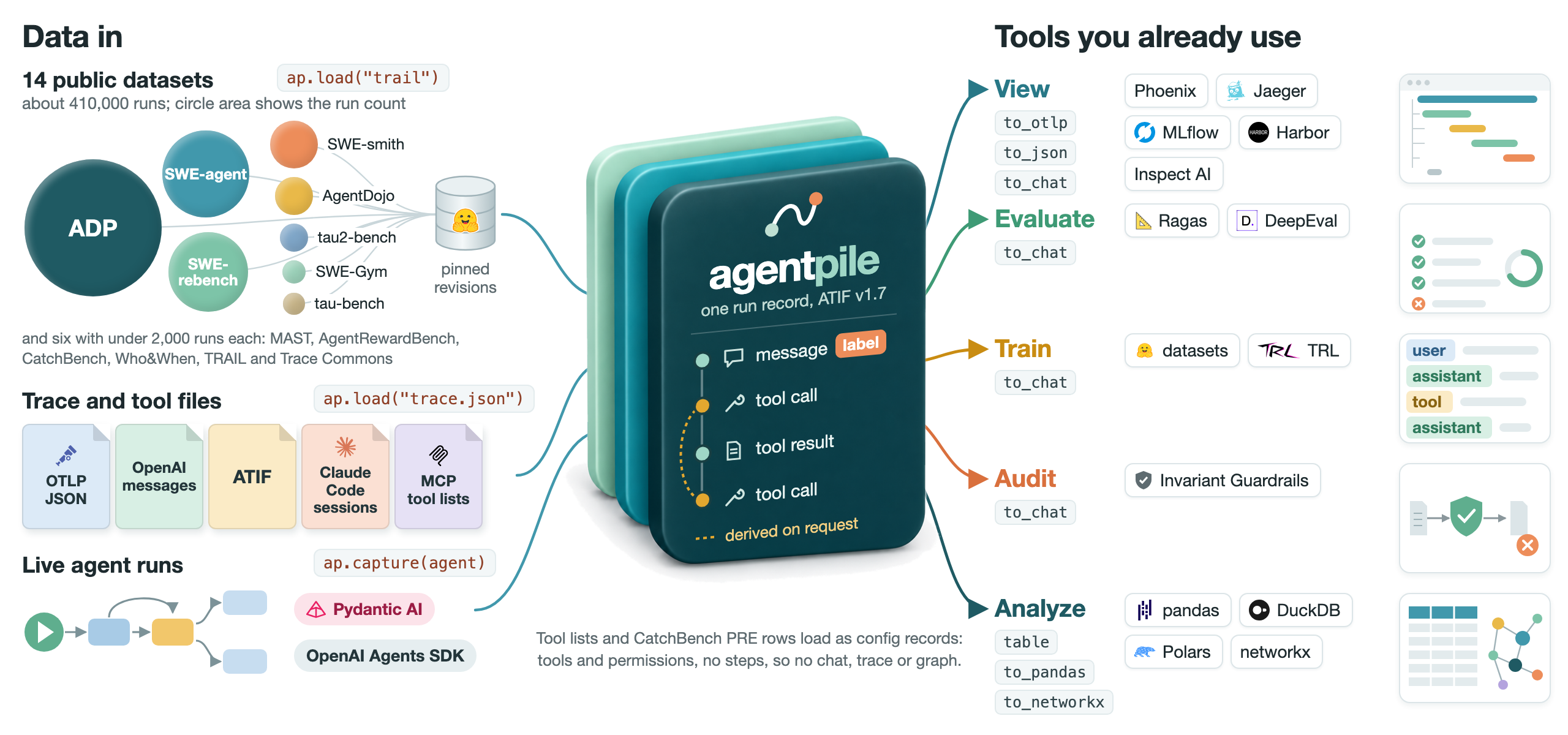
Public datasets store agent runs in their own schemas (e.g., chat messages in tau-bench, OpenTelemetry spans in TRAIL, raw log text in MAST), and each analysis tool expects its own input. agentpile sits between the two. It reads datasets, trace files and live runs into ATIF v1.7 records that keep what the source recorded. You can then use those records with pandas, networkx or a tracing UI such as Phoenix. It downloads each dataset from its publisher at a pinned revision and redistributes nothing.
tau-bench stores plain chat logs. ap.send_otlp posts a run as OTLP spans to Arize Phoenix, Jaeger, MLflow or any OTLP/HTTP collector, and returns the trace ids.
# pip install "agentpile[hf,otel]" arize-phoenix
# phoenix serve    (in a second terminal)
import agentpile as ap

run = next(ap.load("tau_bench", limit=1))
ap.send_otlp(run, "http://localhost:6006/v1/traces")   # then open http://localhost:6006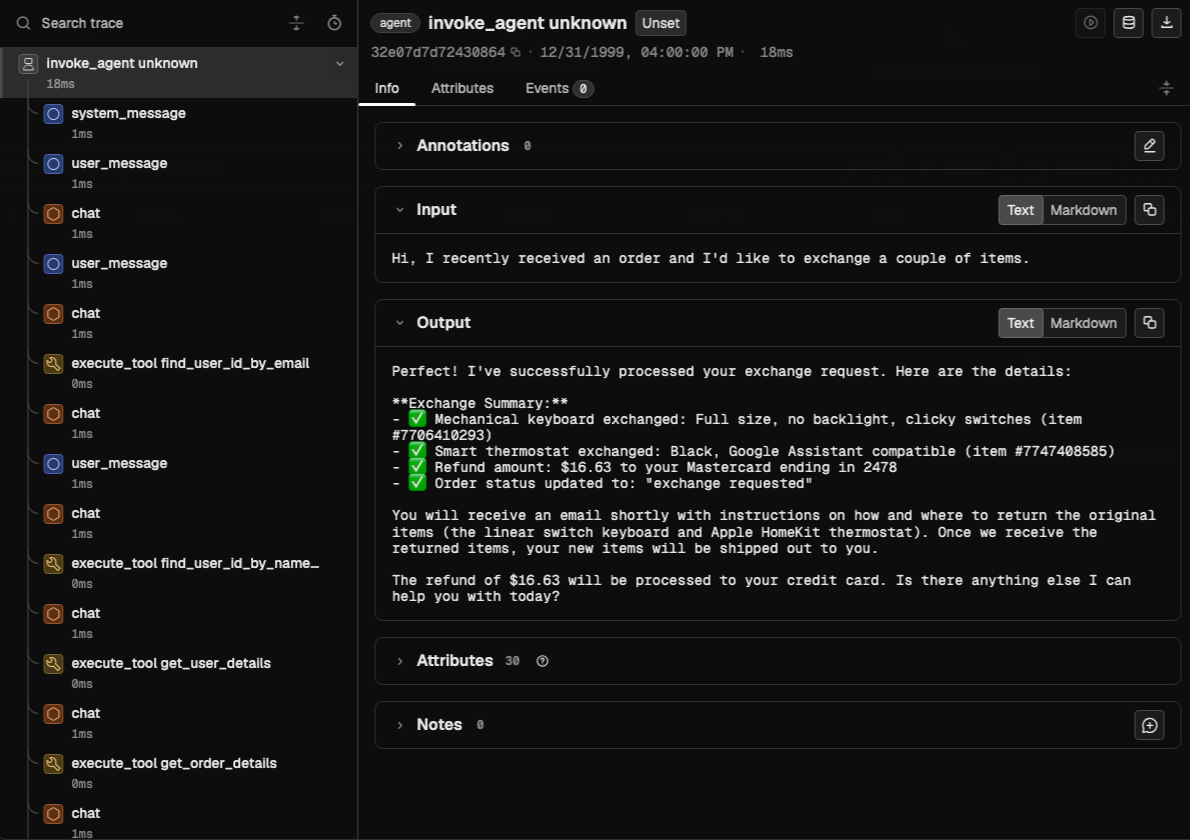
Jaeger takes the same call at http://localhost:4318/v1/traces (UI on port 16686), and MLflow at http://localhost:5000/v1/traces with headers={"x-mlflow-experiment-id": "0"} to pick the experiment. Harbor and Inspect AI read files: the view-harbor and view-inspect recipes write any runs as a Harbor job or an Inspect log and print the command that opens it (python examples/integrations/view-harbor/view_harbor.py tau_bench prints open with: harbor view DIR).
A run whose source has no timestamps gets synthetic ones that only order its spans. The durations a viewer shows for such a run are therefore not runtime measurements.
Who&When blames a step, TRAIL marks error spans, and MAST flags 14 failure modes per run. One table holds all three (figure script).
# pip install "agentpile[hf,pandas]"   (downloads about 260 MB once)
# TRAIL is gated: accept its terms on Hugging Face and log in first (section 3)
import agentpile as ap

runs = [run for name in ("who_and_when", "trail", "mast") for run in ap.load(name)]
labels = ap.to_pandas(runs, "labels")   # run_id, name, value, target_kind, label_source, step, span, ...  (step is empty for span labels)
print(labels.groupby(["label_source", "target_kind"]).size())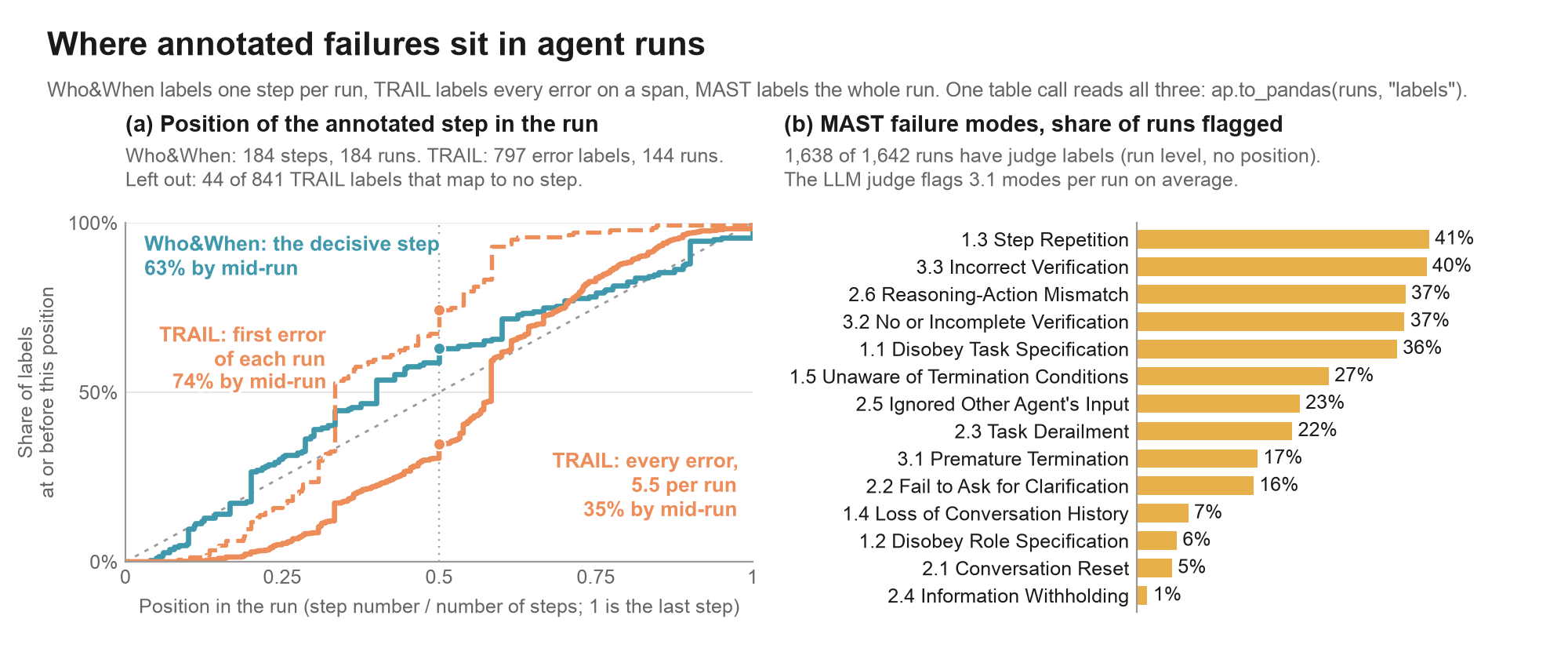
Which earlier result does each call reuse? When a call reuses an id-like value from an earlier result, the value_flow rule makes it depend on the call that produced that result. Such values include reservation ids, product ids and dates. The links are inferred from the recorded values (figure script).
# pip install "agentpile[hf,graph]"
import agentpile as ap

run = next(ap.load("tau_bench", limit=1))
deps = ap.derive_deps(run, rules=["value_flow"])        # each entry names its rule and version
graph = ap.to_networkx(run, rules=["value_flow"])       # events as nodes, dependencies as edges
print(len(deps), deps[0]["resource"])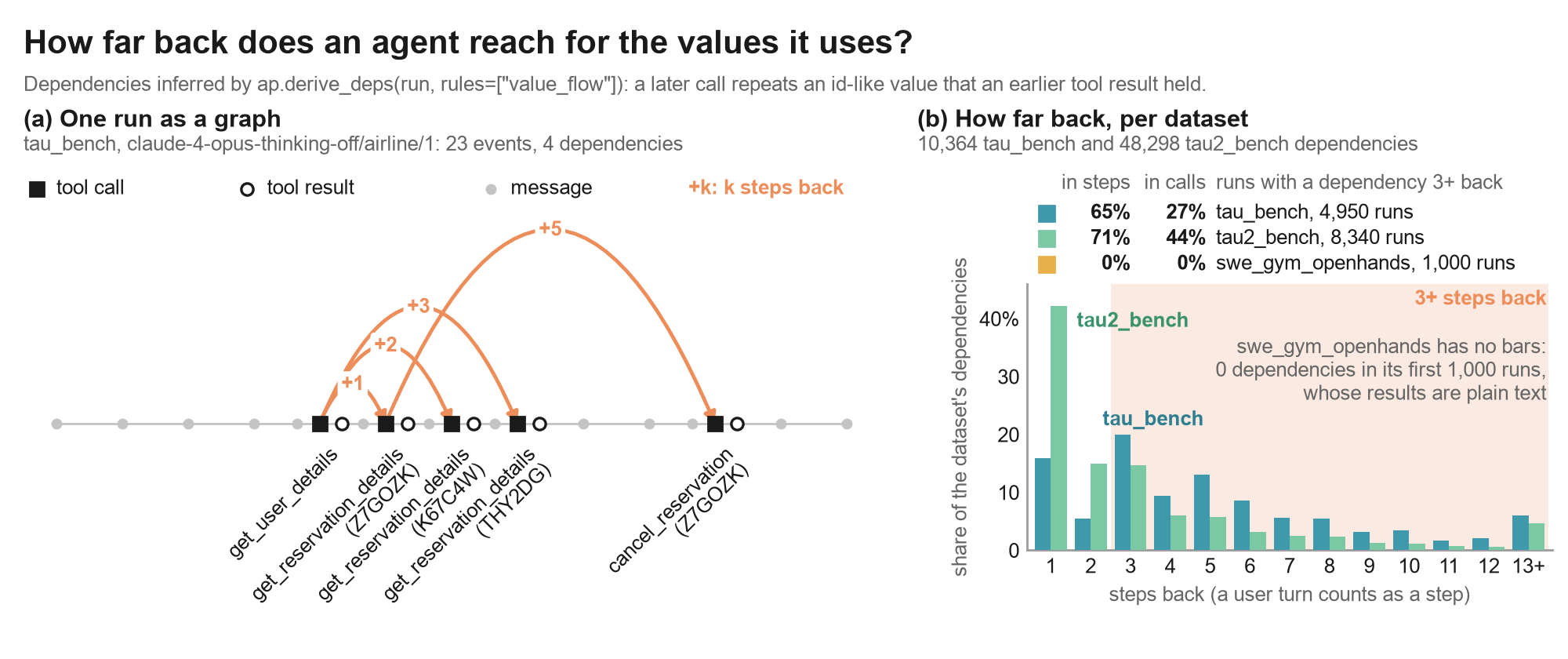
The same record feeds tools for evaluation, training, auditing, analysis and viewing. ap.to_chat turns runs into OpenAI-style chat rows with their tools, ap.table into flat tables, and run.to_otlp and run.to_json into traces and ATIF files. Each row below is a recipe that CI runs every week at the version shown, offline on the bundled fixtures (how the rows are checked), and each also runs on your own runs (e.g., python examples/integrations/evaluate/evaluate.py tau_bench --limit 20).
| Use | Tool | Check | Tested version | Status | Last passing check | Recipe |
|---|---|---|---|---|---|---|
| Evaluate | Ragas | tool-call F1 and accuracy, no model | 0.4.3 |  |
 |
evaluate |
| Evaluate | DeepEval | tool correctness, judge never called | 4.3.1 | |
|
evaluate |
| Train | Hugging Face datasets, TRL | round trips, assistant-only labels | 5.1.0, 1.16.0 |  |
 |
train |
| Audit | Invariant Guardrails | data-flow and ordering rules | 0.3.5 |  |
 |
audit |
| Analyze | DuckDB, Polars | same answers, Parquet round trip | 2.0.0, 2.0.0 |  |
 |
analyze |
| View | Harbor (harbor view) |
ATIF loads and is served | 0.24.0 |  |
 |
view-harbor |
| View | Inspect AI (inspect view) |
eval log reads back and is served | 0.3.283 |  |
 |
view-inspect |
| View | OTLP receivers | exports parse as OTLP and read back | proto 1.45.1 |  |
 |
view-otlp |
| View | Arize Phoenix | every trace sent is found | 20.24.0 |  |
 |
view-otlp |
| View | Jaeger | every trace sent is found | 2.22.0 |  |
 |
view-otlp |
| View | MLflow | every trace sent is found | 3.17.2 |  |
 |
view-otlp |
Your own runs reach these tools through two calls:
# pip install "agentpile[hf]"
import agentpile as ap

runs = [run for run in ap.load("tau_bench", limit=20) if run.outcome["success"]]
rows = ap.to_chat(runs)             # Hugging Face datasets, TRL; arguments="dict" for Ragas, DeepEval, Invariant, Inspect AI
events = ap.table(runs, "events") # DuckDB and Polars, through Parquetpip install agentpile # the core: standard library only
pip install "agentpile[hf,view]" # adds dataset downloads and the colored ap.show| Extra | Adds |
|---|---|
hf |
downloads of the Hugging Face datasets |
view |
colored ap.show output (rich); without it the view is plain text |
pandas, graph |
ap.to_pandas and ap.to_networkx; ap.table gives the same rows with the core alone |
otel |
protobuf for ap.send_otlp to a receiver that takes only protobuf, such as Phoenix (Python 3.10+) |
pydantic-ai, openai-agents |
ap.capture for Pydantic AI (Python 3.11+) and the OpenAI Agents SDK (Python 3.10+) |
A conversation in the OpenAI chat format needs only the core:
import agentpile as ap

messages = [
    {"role": "user", "content": "Is it raining in Paris?"},
    {"role": "assistant", "content": None, "tool_calls": [{"id": "call_1", "type": "function",
        "function": {"name": "get_weather", "arguments": "{\"city\": \"Paris\"}"}}]},
    {"role": "tool", "tool_call_id": "call_1", "content": "light rain, 14 C"},
    {"role": "assistant", "content": "Yes, light rain."},
]
run = next(ap.load(messages))             # the format is detected, and an ambiguous input is an error
for event in run.events():                # messages, tool calls and tool results in source order
    print(event.kind, event.role, event.content)

for dep in ap.derive_deps(run, rules=["tool_call_id"]):   # inferred only when you ask, by a named rule
    print(dep["rule"], "step", dep["src"]["step"], dep["src"]["call"], "-> step", dep["dst"]["step"])

run.to_json("run.json")                   # ATIF v1.7 JSON; run.to_otlp("run.otlp.json") writes OTLP spans
rows = ap.to_chat(run)                    # chat rows with tools for training and evaluation; here, the same messages
message user Is it raining in Paris?
message agent None
call agent {'city': 'Paris'}
result tool light rain, 14 C
message agent Yes, light rain.
tool_call_id step 2 call_1 -> step 3
The None in the second line is the null of the source's first assistant message: ATIF has no null there, so the record holds an empty string and notes what the source had. Rule tool_call_id makes the next agent step after a result depend on the call that produced it, here the final answer (step 3) on call_1 in step 2.
Logs from your own framework load the same way once they are OpenAI-style messages, in memory or in a JSON or JSONL file. A dataset loads by name (ap.datasets.names() lists them), and a trace file by its path (ap.readers.names() lists the formats):
# pip install "agentpile[hf]"
import agentpile as ap

for run in ap.load("who_and_when", limit=5):   # fetches only the files these five runs come from
    print(run.id, [(label["name"], label["value"]) for label in run.labels])   # the labels the reader emits
run = next(ap.load("run.json")) # the ATIF file written above; also OpenAI messages, OTLP JSON, a tool list or a Claude Code sessionEach name loads one dataset at the revision shown, and a full load is checked against the run count in its manifest. Harbor's ATIF v1.7 models (Harbor 0.22.0) accept every trajectory checked: the first 3,000 runs of each dataset, or all of a smaller one. tools/dataset_table.py regenerates this table.
| Name | Source at pinned revision | Runs | Source annotation levels | License on the card |
|---|---|---|---|---|
who_and_when |
Kevin355/Who_and_When @ 59b9fcb |
184 | run, step | not declared |
mast |
mcemri/MAST-Data @ 95118ac |
1,642 | run | cc-by-4.0 |
trail |
PatronusAI/TRAIL @ b424ce6 |
148 | run, span | mit |
tau_bench |
AgentSuite/tau-bench-trajectories @ 382e57d |
4,950 | run | not declared |
tau2_bench |
AgentSuite/tau2-bench-trajectories @ 07264f1 |
8,340 | run | not declared |
agent_reward_bench |
McGill-NLP/agent-reward-bench @ b6d17e6 |
1,302 | run | not declared |
agentdojo |
sungjuncho/agentdojo-trajectories @ 43df1b8 |
15,095 | call, run, span | not declared |
swe_rebench_openhands |
nebius/SWE-rebench-openhands-trajectories @ 3545538 |
67,074 | run | cc-by-4.0 |
swe_agent_nebius |
nebius/SWE-agent-trajectories @ 68195a1 |
80,036 | run, step | cc-by-4.0 |
swe_gym_openhands |
SWE-Gym/OpenHands-Sampled-Trajectories @ baf3a4e |
6,055 | run | not declared |
swe_smith |
SWE-bench/SWE-smith-trajectories @ 08e109b |
24,100 | run, step | mit |
adp |
neulab/agent-data-collection @ 31a76bf |
200,914 | run | not declared |
trace_commons |
trace-commons/agent-traces @ 112ebd4 |
28 | none | cc-by-4.0 |
catchbench_pre |
yzhao062/catchbench @ 30a516c |
1,187 | run, tool | MIT; rows name their upstream license |
Warning
TRAIL's harness logs contain GAIA reference answers and SWE-bench gold patches. agentpile keeps them as recorded. Remove them before you show a TRAIL run to an agent under test, using the gold_note of the TRAIL manifest, which names each field.
Notes on the table and on single datasets
- Annotation levels. The column lists the levels at which each source annotates its runs, as its manifest records them. Readers turn part of these annotations into
run.labels: run labels for every dataset except ADP, plus step and agent labels for Who&When, span labels for TRAIL and tool labels for CatchBench PRE. The rest stay elsewhere in the record (e.g., ADP's results inrun.outcome, SWE-smith's patch inrun.dataset). - TRAIL is gated on Hugging Face: accept its terms on the dataset page with the account whose token you use.
- AgentRewardBench run files total about 30 GB, because each step keeps the browser state the agent saw.
limit=fetches only the run files it reads. - SWE-smith loads its
toolsplit. 14,984 of its 24,100 rows write actions as text and load as plain messages, andmessage_format="native"returns only the 9,116 rows with structured calls. - Trace Commons loads only its Claude Code sessions, 28 at the pinned revision: enough for tests and examples, too few to draw conclusions from. Its Cursor and opencode files have no reader.
- ADP loads the 14 configurations whose records pass validation and a count check, and the manifest lists the rest. The loader follows ADP's own ADP-to-ATIF converter with two changes, both to keep the source's roles. An environment observation that answers no call becomes a user step whose
roleisenvironment, where ADP's converter makes it an empty agent step. A call's result keeps the observation's ownsource, where ADP's converter relabelsuserasenvironment.
Have agent trajectories or a trace format that agentpile does not load yet? Open an issue with a link and we write the loader, the manifest and the tests. A pull request with a loader is welcome too (see Extending).
ap.capture records a run of a Pydantic AI agent or an OpenAI Agents SDK agent (pip install "agentpile[openai-agents]") into the same record, with the agent's configuration attached.
# pip install "agentpile[pydantic-ai]"
import agentpile as ap
from pydantic_ai import Agent
from pydantic_ai.models.test import TestModel

my_agent = Agent(TestModel(), name="my_agent")   # TestModel answers without a model key

with ap.capture(my_agent) as cap:
    my_agent.run_sync("Book a flight from LAX to SFO.")
ap.show(cap.run)           # the captured run
cap.otlp                   # the same spans as an OTLP JSON document
ap.config_from(my_agent)   # the configuration alone: instructions, model, tools with schemas, handoffs
Capture is tested with Pydantic AI 2.58.0, 2.59.0, 2.60.0 and 2.61.0 and with the OpenAI Agents SDK 0.24.0 through openinference-instrumentation-openai-agents 2.5.3. agentpile checks the version of the instrumentation that wrote the spans, which is Pydantic AI itself or, for the Agents SDK, OpenInference. With any other instrumentation version cap.run raises an error, and ap.capture(my_agent, allow_untested_version=True) builds the run anyway and marks it source.dialect_tested false.
Which runs a capture records
A capture uses its own tracer provider and never sets the global one. Observers the host program already had keep receiving every span, and the agent's original instrumentation setting is restored when the block exits, including on an exception. Everything a capture records happens while the block is open and only for the agents passed to capture(). Runs of other agents in the same window are not recorded. What counts as a selected agent's run depends on the framework. For the Agents SDK, a trace in which a selected agent takes part (it starts the run, receives a handoff, or is called as a tool) is recorded whole, other participants included. Because the SDK names agents only by name in its spans, an unselected agent that shares a selected agent's name is also recorded. For Pydantic AI, each selected agent's own runs are recorded: an agent that a selected agent calls from a tool is recorded only when it is selected too. Pass every agent whose delegated work you want.
A trajectory record is an ATIF v1.7 trajectory, the Agent Trajectory Interchange Format of the Harbor evaluation framework. What ATIF has no field for sits under extra["agentpile"]: where the run came from, the source's labels with their targets, the agents and tools with their permissions, and the source value behind each message or call stand-in. A configuration with no execution (e.g., an MCP tool list) is a config record (agentpile-config/0) with the same agents, tools and labels at its top level and no steps.
Loading never adds what the source did not record: it keeps any dependencies the input states and infers none. The few pairings a reader has to infer carry paired_by with the name of the rule, and ap.derive_deps(run, rules=[...]) infers dependencies between steps when you ask.
What the extension holds, and how inference and export work
- Source and identity: dataset, revision, file, record key and reader version, enough to trace every run back to the row it came from.
- Labels with targets: each label points at the run, an agent, a step, a call, a span or a tool, with the label's origin (expert, LLM judge, benchmark).
- Agents and tools: each agent's instructions, model and tools, and each tool's original definition, its permission, and where that permission came from.
- Stand-ins made visible: where ATIF requires a value the source did not have (a non-null message, an object of arguments, a call id, an image part it cannot hold), the record keeps the source value and the event view reports it. A missing value, a null and an empty string therefore stay distinct. A call whose source arguments were neither a JSON object nor null keeps them in
arguments_rawand carriesarguments_state: "unparsed", and inrun.to_otlp()its model span and its tool span both show that source value. For any other call the model span shows the parsed arguments, and the tool span shows the source text where the reader kept it. - Source order:
run.events()follows the order the source recorded, which differs from ATIF where ATIF stores a result on the step that issued the call (a delegated agent's steps can come in between). A reader whose references are not integers (e.g., TRAIL's span addresses) stores an integer sort position beside each reference (source_pos,result_pos), and the reference itself keeps pointing back into the source.
CatchBench PRE rows load as config records, and so do tool definitions: an MCP tools/list result, an OpenAI tool list and an Anthropic tool list (readers mcp-tools-list, openai-tools and anthropic-tools), each definition kept verbatim. An MCP tool's permission comes from its annotations when it states them and is unknown otherwise.
A Claude Code session file (~/.claude/projects/<project>/<session>.jsonl) loads by its path with reader claude-code-jsonl, and its subagent files load with it, each under the call that started it. Its format is Claude Code's own and has no public specification. The reader was built on 2.1.x files; it records the versions it saw, and run.dataset["accounting"] counts every line it did not map. A session that was edited or rewound keeps every branch, so an export in file order can hold alternatives, which run.dataset["branches"] lists. Local sessions can hold secrets, and agentpile writes what it reads.
Inferred pairings include a result matched to its call by position, a TRAIL history call placed on the latest agent step, and a TRAIL TOOL span tied to its call by a unique match. Every dependency from ap.derive_deps names the rule and version that produced it, and run.with_deps(rules=[...]) returns a copy whose steps carry those entries, which to_otlp() then writes as span links. The run you loaded is not changed.
run.to_otlp() writes a run as OTLP JSON spans in the layout of Harbor's ATIF-to-OpenTelemetry converter. A run loaded from a trace writes each of its source spans once, and a telemetry tool therefore counts the same model and tool operations as in the original trace. The spans agentpile adds around them (the trajectory, user and system steps) are CHAIN spans, not model or tool operations. Reading an OTLP trace whose instrumentation version differs from the tested ones raises an error unless you pass allow_untested_version=True, which marks the record as read from an untested version.
Logs that are OpenAI-style messages need no reader (see Quick Start). Otherwise, a reader is any object with sniff(source) -> bool and read(source) -> Iterator[Run]. Register one for a session with ap.register("my-format", reader), or ship it in a package through the entry-point group agentpile.readers (datasets and writers have agentpile.datasets and agentpile.writers). Pass reader="..." to ap.load to skip detection.
Downloaded files live in one place, ~/.cache/agentpile/<dataset>/<revision>/ (set AGENTPILE_CACHE to move it), and never in the shared Hugging Face cache. A load with limit= fetches only the files its runs come from, and a later full load fetches the rest. Until a full download completes, each limited load still asks the hub for its file listing. ap.cache_info() lists what is there and ap.clear_cache() removes it.
Alpha. Version 0.3.1 covers the 14 datasets above, each checked against a manifest of pinned counts, the ATIF, OpenAI-style message, OTLP JSON, tool-definition, agentpile config and Claude Code session formats, capture for Pydantic AI and the OpenAI Agents SDK, and chat rows for training and evaluation; the tools in section 1.4 are checked weekly. The record format may still change before 1.0, and the changelog lists every change.
Apache-2.0 for the code. Each dataset keeps its publisher's terms. Several declare no license on their dataset card, and agentpile records what each card says in its manifest. The tests use synthetic fixtures in each dataset's file layout and copy no dataset content. The tool logos in the overview figure belong to their projects and keep their own terms (sources). The name follows the habit of calling a mixed collection a pile and has no connection to EleutherAI's The Pile.